

42 | AUGUST 22 • 2024
Local artist helps Israelis
heal through sand art.
Art
Healing
as
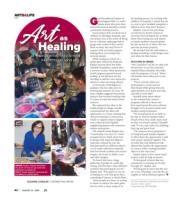
ABOVE: Kaplan relayed directions
via Zoom on how to use sand and
adhesives to create art.
RIGHT: Israeli directors manning the
art tables in a family park.
Gail
Rosenbloom
Kaplan
ARTS&LIFE
ART
SUZANNE CHESSLER CONTRIBUTING WRITER
G
ail Rosenbloom Kaplan of
Farmington Hills is a multi-
media artist who gives time
and professional leadership to build
community-healing projects.
Some projects have reached out to
children in Michigan hospitals, and
one project was at the center of flying
her to a Haitian orphanage before
gangs took control of the country.
Most recently, she used Zoom to
connect with an Israeli program
helping those recovering from
terrorist attacks.
While reading an article in a
publication offered by Hadassah,
Kaplan learned about the Koby
Mandell Foundation, named after
a terrorist victim, which sponsored
Israeli programs geared toward
healing. It was the basis for her
deciding to add her own instructive
talents to what was being offered.
A University of Michigan art
graduate who has taken part in
professional interests for some 40
years, Kaplan suggested functional
projects that involved working with
15 colors of sand and sticky board
surfaces.
She expressed her ideas to the
Israeli people in charge, and she
communicated her ideas and
approaches in a Zoom meeting that
showed techniques to instructors.
Funds to support project supplies
were collected from Kaplan’s
neighboring donors who wanted to
remain anonymous.
The original article Kaplan saw,
“Community Can Save Us,” which
prompted her to think about how
to design with sand and adhesive
materials, infused the way she
demonstrated how different objects
can be made with those materials
and how Jewish symbols and various
images can be put on dishes, trays
and other designs.
“In Israel, they have a large
gathering of people in a park-like
setting, and they have many different
activities that participants can do,”
Kaplan said. “The goal is to use art
as healing in a way that gives them
something of interest to think about.
“Some people use dance or writing
or music to achieve the same goals,
but my work is about using art in
the healing process. In working with
children in hospitals, I found that art
is a way to give troubled youngsters a
different focus than their illnesses.”
Kaplan’s concern for providing
art interests to Israeli victims of
terrorism first prompted her to think
about those facing loss and injuries
to family members of participants,
but she moved on to those who lost
precious personal property.
She decided that the individuals in
healing workshops could design some
new items for their homes.
SUCCESS IN ISRAEL
“Our counselors ran the art table and
showed how to use the materials,”
emailed Eliana Mandell, who helps
with the programs in Israel. “About
200 families have taken part in our
projects.
“These activities allow our
participants to create and use
their hands while giving them the
opportunities to sit down and relax
and talk to each other.”
Mandell made observations
as she evaluated the various
programs offered to those who
have experienced the severe distress
brought on by terrorist attacks and
needed coping techniques.
“We incorporated an art table on
the day we had for families before
Pesach where they could create sand
art that was Pesach-related,” Mandell
said. “It was a day with rock climbing,
laser tag and great food.
“The purpose of our programs is
to bring bereaved families together
to allow them the opportunity to talk
and connect and heal together. The
art table that Gail helped provide
allowed the families the opportunity
to connect while creating beautiful
objects at the same time.”
Kaplan hopes to have more Israeli
projects with the help of donors.
“It feels good to know that our
community is reaching out to help
through art,” Kaplan said.
“It feels good to know that the arts
are a way of healing. I provide the art
supplies as well as financial support.”
For those interested in supporting more healing
projects in Israel, contact
kobymandell.org. (201) 699-9944.