

38 | AUGUST 22 • 2024 J
N
W
hat is the real challenge
of maintaining a free
society? In parshat
Ekev, Moses springs his great
surprise. Here are his words:
“Be careful that you do not forget
the Lord your God … Otherwise,
when you eat and are satisfied,
when you build fine
houses and settle
down, and when your
herds and flocks grow
large and your silver
and gold increase
and all you have is
multiplied, then your
heart will become
proud and you will forget the Lord
your God, who brought you out of
Egypt, out of the land of slavery …
You may say to yourself, ‘My power
and the strength of my hands have
produced this wealth for me.’ … If
you ever forget the Lord your God
… I testify against you today that
you will surely be destroyed.” Deut.
8:11-19
What Moses was saying to
the new generation was this:
You thought that the 40 years of
wandering in the wilderness were
the real challenge, and that once
you conquer and settle the land,
your problems will be over. The
truth is that it is then that the real
challenge will begin. It will be
precisely when all your physical
needs are met — when you have
land and sovereignty and rich
harvests and safe homes — that
your spiritual trial will commence.
The real challenge is not poverty
but affluence, not insecurity
but security, not slavery but
freedom. Moses, for the first time
in history, was hinting at a law
of history. Many centuries later,
it was articulated by the great
14th century Islamic thinker, Ibn
Khaldun (1332-1406), by the Italian
political philosopher Giambattista
Vico (1668-1744) and, most
recently, by the Harvard historian
Niall Ferguson. Moses was giving
an account of the decline and fall of
civilizations.
Ibn Khaldun argued similarly,
that when a civilization becomes
great, its elites get used to luxury
and comfort, and the people
as a whole lose what he called
their asabiyah, their social
solidarity. The people then become
prey to a conquering enemy, less
civilized than they are but more
cohesive and driven.
Vico described a similar
cycle: “People first sense what is
necessary, then consider what is
useful, next attend to comfort, later
delight in pleasures, soon grow
dissolute in luxury, and finally go
mad squandering their estates.”
Bertrand Russell put it
powerfully in the introduction
to his History of Western
Philosophy. Russell thought that
the two great peaks of civilization
were reached in ancient Greece
and Renaissance Italy. But he was
honest enough to see that the very
features that made them great
contained the seeds of their own
demise:
“What had happened in the great
age of Greece happened again in
Renaissance Italy: traditional moral
restraints disappeared because
they were seen to be associated
with superstition; the liberation
from fetters made individuals
energetic and creative, producing
a rare fluorescence of genius; but
the anarchy and treachery that
inevitably resulted from the decay
of morals made Italians collectively
impotent, and they fell, like the
Greeks, under the domination
of nations less civilized than
themselves but not so destitute of
social cohesion.”
Niall Ferguson, in his
book Civilization: the West and
the Rest (2011), argued that the
West rose to dominance because
of what he calls its six “killer
applications:” competition, science,
democracy, medicine, consumerism
and the Protestant work ethic.
Today, however, it is losing belief
in itself and is in danger of being
overtaken by others.
All of this was said for the first
time by Moses, and it forms a
central argument of the book of
Devarim. If you assume — he tells
the next generation — that you
yourselves won the land and the
freedom you enjoy, you will grow
complacent and self-satisfied.
That is the beginning of the end
of any civilization. In an earlier
chapter, Moses uses the graphic
word venoshantem, “you will grow
old” (Deut. 4:25), meaning that
you will no longer have the moral
and mental energy to make the
sacrifices necessary for the defense
of freedom.
Inequalities will grow. The rich
will become self-indulgent. The
poor will feel excluded. There will
be social divisions, resentments
and injustices. Society will no
longer cohere. People will not
feel bound to one another by a
bond of collective responsibility.
Individualism will prevail. Trust
will decline. Social capital will
wane.
This has happened, sooner or
later, to all civilizations, however
great.
To the Israelites — a small people
surrounded by large empires — it
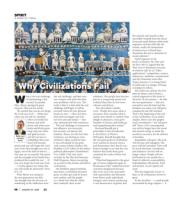
Why Civilizations Fail
Why Civilizations Fail
Rabbi Lord
Jonathan
Sacks
SPIRIT
A WORD OF TORAH
BY JUAN CARLOS FONSECA MATA