

4 | AUGUST 8 • 2024
J
N
opinion
Rebuilding the Jewish
Brand in America
W
hat is the central
vibe in the Jewish
world today? In a
word, anxiety.
Justified
anxiety, I might
add.
It seems
everywhere
we turn, there
are anti-Israel
and anti-
Jewish forces
mobilizing for action. The
hatred and chutzpah have
reached new levels. There’s no
fear, for example, about spray
painting “Hamas is Coming”
on a statue in Washington,
D.C., or assaulting Jews
outside a synagogue in my
Los Angeles neighborhood of
Pico-Robertson.
The good news is that Jews
have mobilized in response.
We have our rights and we’re
fighting to enforce them.
Haters must pay a price.
Lawsuits are being filed.
Scores of organizations are on
the case. We’re making noise.
All of this fighting is crucial,
and we must never relent.
Indeed, we cover the fighting
extensively in the Jewish
Journal. But that’s not why I’m
writing this column; you don’t
need me to repeat the obvious.
I’m writing to bring
attention to an unusual side
effect in the fight against
antisemitism; one that is not
easy to see. This side effect, if
we don’t take action, has the
potential to severely weaken
the Jewish brand in America.
Let me explain.
A brand is as valuable as
a reputation. That applies to
organizations, individuals and
products as well to groups of
people. The Jews in America
have always been blessed with
a strong brand, one that is
marked, among other things,
by our inclination to give back
to our country.
How is the fight against
antisemitism influencing that
brand?
Branding is all about the
noise we make. That noise
helps shape the brand we
become. Right now, the Jewish
noise in America is very much
about fighting those who hate
us. Whether we like it or not,
we’re becoming the group that
cares mostly about protecting
itself.
This is not a criticism.
Fighting for safety is
primordial. It does, however,
hold a subtle trap: Safety
is so important that it tends
to drown out everything else,
to suck up all the noise. As a
result, Jews become associated
with weakness; fear on one
side; and seeking safety on the
other.
This not only “shrinks” the
Jewish brand, but it’s also not
true to who we are.
The Jewish way, which
promotes growth, goodness
and renewal, has always
treated safety as a beginning,
not an end.
Perhaps the ultimate
example is Israel. In its 76
years of existence, no country
has been under more physical
threat than the world’s
only Jewish state. And yet,
it is known not just for its
strong military but for its
vibrancy and creative spirit,
not to mention its many
contributions to the world.
As critical as safety is, Israel
reminds us that there’s a lot
more to the Jewish brand than
seeking protection.
In America, no group has
contributed more than the
Jews. From comedy to science
to academia to literature to
Broadway to Hollywood to
social justice to endless other
fields, the Jewish reputation
has sparkled because Jews
are natural contributors.
Antisemitism or no
antisemitism, our brand has
always been dominated by our
giving gene.
I bumped into one of
my favorite Jewish “givers”
recently — Matisyahu. I
mentioned that infamous
concert in Spain where he
sang the “Jerusalem” song in
front of anti-Israel protestors.
He remembered it well. What
I loved, I told him, is that he
didn’t use his position on stage
to verbally push back on the
haters who wanted to shut
him down.
No, all he did was sing.
And boy did he sing. While
the haters hated, Matisyahu
did what he does best. He
performed. He gave of himself
to the audience.
Giving of ourselves has
been the American Jewish
way since we landed on these
shores.
Now that we’re feeling
under siege, that Jewish way
is being tested. Naturally, the
noise is going to the act of
fighting the haters, of seeking
protection. It’s understandable.
David Suissa
JNS.org
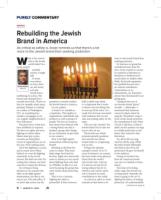
COTTONBRO STUDIO/PEXELS.
PURELY COMMENTARY
continued on page 6
As critical as safety is, Israel reminds us that there’s a lot
more to the Jewish brand than seeking protection.
Y
our eyes are precious, and
vital to your indepen-
dence, and at Shanbom
Eye Specialist, our doctors have
the goal of providing eye care
they’d give to their own family.
That philosophy guides every
decision — starting with the
exam, advice and individualized
treatment plans for conditions
such as dry eyes and cataracts.
“Our tailored treatment
plans mean that your plan is
your own,” said Dr. Steven A.
Shanbom, M.D., a board-certi-
fied ophthalmologist specializing
in cataract and refractive surgery.
“There is no one size fits all.”
Dr. Shanbom and Dr. Amanda
Salter, M.D., both board-certified
comprehensive ophthalmologists,
bring their expertise and passion
for eye care to every appoint-
ment. They treat the whole
eye and can help patients with
cataracts, glaucoma, dry eye and
vision care. They specialize in pre-
mium cataract surgery, including
cutting-edge lens implants and
innovative treatments for dry eyes
— providing relief for this occa-
sionally debilitating condition.
“If you live long enough, you
will experience cataracts,” Dr.
Shanbom said. “And there is a
difference in surgical options,
and how to navigate your choic-
es, especially when it comes to
implant lenses.”
Cataracts are when the eye
lens becomes cloudy overtime
and Dr. Shanbom said it requires
surgery to replace the lens.
Advances in the options for lenses
means patients can experience a
correction of conditions such as
astigmatism or near- and farsight-
edness — potentially reducing or
eliminating the use of glasses to
correct vision.
“The Holy Grail for an eye
surgeon is to correct vision so a
patient can see both far and near
without glasses or contacts,” he
said. “And we provide several dif-
ferent options for lens implants.
They are not all created equal,
and we can help patients choose
the best and safest option.”
Dr. Shanbom does custom
imaging and examinations to
determine each patient’s needs
when it comes to premium cata-
ract surgery, making sure the best
possible option and outcome is
achieved. Patients can rest assured
that they have all the information
needed to make this decision on
treatment.
“We do this very well,” Dr.
Shanbom said. “We give our
patients our best advice and rec-
ommendation so they can make
their best decision. And we get
very good results with very few
complications.”
Shanbom Eye Specialist has its
own two-room operating suite, so
procedures are done in-house —
instead of in a hospital. And also
on-site is a Dry Eye Clinic, where
Dr. Salter works with patients to
improve or eliminate this often
painful or debilitating condition.
“Dry eye is like an epidemic,”
Dr. Shanbom said. “It can be a
result of aging, a side effect of
medication or a medical condi-
tion or as a result of technology
use.”
The condition can range from
mild to severe, and treatment
plans can vary, consisting of
prescription eye drops, oil gland
treatments, tear car, eyelid care
and tear plugs.
“A lot of the time, this con-
dition is not taken seriously but
you don’t have to just live with
it,” Dr. Shanbom said. “There are
many things we can do.”
Dr. Shanbom and Dr. Salter
are specialists in premium eye
care and surgical options, and
their customized treatment
plans and professionalism mean
patients can rest assured they are
in the best hands when it comes
to vision conditions and correc-
tion.
“The well-being of our patients
is of the utmost importance
here,” said Dr. Shanbom. “We
treat the whole eye. And we treat
our patients the same way we’d
treat our family.”
SHANBOM EYE SPECIALIST
28747 Woodward Ave.,
Berkley, Mich. 48072
(248) 368-0007
info@shanbomeye.com
www.shanbomeye.com
SPONSORED BY SHANBOM EYE SPECIALIST
Personalized,
state-of-the-art care
is the hallmark of
Shanbom Eye
Specialist