

14 | JULY 11 • 2024
even summer breaks couldn’t
separate these two.
“Our summers were spent
happily employed at Camp
Tamarack,
” Myles said. “Linda
was a counselor, and I had a
wide range of jobs including
dishwasher, kitchen porter,
baker’s assistant, salad chef
and truck driver. One of my
fellow kitchen porters was Alan
Hitsky, formerly of the JN staff.
”
Turns out the Lash family has
an extraordinarily long history
with the camp. Amazingly,
Myles’ mother, Rose, was a
camper in the 1920s. And a
Lash family member has been a
camper, counselor, staff mem-
ber or board member in every
decade since.
I think it’s safe to say that
Myles and Linda Lash took
their loyalty to Camp Tamarack
to a whole other level. Just a
few days after their June 1968
wedding, and a brief two-day
Toronto honeymoon, they
found themselves chaperoning
what Myles recollects was a
busload of “screaming, hor-
mone-unbalanced” Tamarack
teenagers on a cross-country
adventure.
This “second” honeymoon
included two separate trips
— commonly referred to as
Tamarack’s Eastern Trip and
Western Trip. Myles drove the
old-style green school bus. In
total, they were on the road for
seven weeks.
“We loved it,
” Linda said. “It
was a wonderful time for both
of us. And I don’t think we
would have done it any differ-
ently. You know, in hindsight, it
was just a great adventure.
”
Myles said, “We pitched
tents every evening. The fun-
niest thing I remember, was
one night, as Linda and I were
perched together in our tent, a
big gale force windstorm came
by and blew our tent down.
We looked up to find ourselves
being stared at by 16 kids.
Apparently, one of their evening
activities was wondering what
the newlyweds were up to.
”
THE ‘WRITE’ TIME
Myles Lash has long been a
student of the Civil War, a
passion he inherited from his
father, Irving, who loved mili-
tary history. Myles’ interest was
further heightened by his time
spent living and working in
Richmond, Virginia, the capital
of the Confederacy.
“I was the executive direc-
tor of the Medical College
of Virginia Hospitals,
” said
Lash, “an institution that has a
remarkable history predating
the Civil War.
”
Retirement and the COVID
19 pandemic gave Myles the
time and opportunity to create
a historical fiction novel that
combined his interests in the
Civil War with an homage for
his love for Detroit and the state
of Michigan.
Imminent Peril tells the story
of Michigan’s Fifth Cavalry. It
is a fascinating and educational
read that reflects Lash’s meticu-
lous research into the subject.
“The unit was actually
inducted into the Army in 1862
and did their training at Fort
Wayne in Detroit,
” Lash said.
“Most of the soldiers in the
book are drawn from
the actual Union
Army ranks and the
text incorporates
their real names.
”
Among the photo-
graphs in the book
is one of the fort’s
remaining barracks.
Lash said he wrote
the book because he
was specifically interested in
three historical milestones: the
battle of Gettysburg, the impris-
onment of calvary soldiers at
the Andersonville prison camp
and the sinking of the Sultana
steamboat. After extensive
research, Myles found that the
Michigan 5th Calvary Regiment
had experience with all three
events.
“It is a story of hardship and
how much humans can endure,
”
Lash said. These Michigan
troops fought in some of the
bloodiest and most critical bat-
tles, including Gettysburg. Later,
some members of the Fifth
Calvary were incarcerated at the
Andersonville prison camp.
Unfortunately, following
the survivors’ release from
prison, they were assigned to
the Sultana riverboat for an
ill-fated passage home. The
Sultana was a former commer-
cial side-wheel steamboat that
was often commissioned to
transport troops. It sank when
its four boilers exploded on
the Mississippi River on April
27, 1865. The death of 1,167
people, including men from the
Fifth Calvary, is still, to this day,
the worst maritime disaster in
United States history.
ON THE ROAD AGAIN
Their upcoming 60th Mumford
High School reunion will be
Myles and Linda Lash’s sec-
ond trip back to Michigan
since May when they attended
their grandson Max’s gradu-
ation from the University of
Michigan.
They no doubt
will pore over an
edition of the Capri,
the name of the
Mumford 1964 High
School yearbook,
which Myles said
was “solemnly dedi-
cated to the memory
of President John
Fitzgerald Kennedy.
”
“We’re also looking forward
to seeing other Mumford cou-
ples like ourselves, who attend-
ed the prom with us and even-
tually married,
” he said. “We
will also respectfully remember
those that departed too soon.
“High school reunions can be
bittersweet. After 60 years, there
will be stories of good times
and some sad reflections of the
loss of classmates, but the mem-
ories of our Mumford days will
be among the best.
”
Added Linda, “You know, in
talking to people that are of my
age that did not go to Mumford,
it’s kind of interesting to me to
find out how many of them did
not really enjoy high school,
whereas I thought they were
absolutely fabulous years.
”
I would expect nothing less
from the captain of the 1964
Mumford High School cheer-
leading squad. Go, Mustangs!
continued from page 12
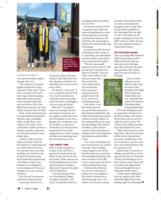
Linda and
Myles Lash at
grandson Max’s
graduation from
U-M