

4 | JULY 11 • 2024
J
N
PURELY COMMENTARY
essay
Unexpected Bonus of Jewish Exhibit
O
n the first day of
the exhibit, “In the
Neighborhood:
Everyday Life on Hastings
Street,
” at the Detroit Historical
Museum, I was greeted by a
man wearing
shorts and a
Detroit Tigers
baseball cap. He
stood inside near
some displays and
looked around at
the objects and
the texts.
“What is this? he asked in a
booming voice.
I explained that he had
entered Jewish Historical
Society of Michigan (JHSM)’s
exhibit about the first Jewish
neighborhood in Detroit. He
continued to read the explana-
tion of the Jews from Eastern
Europe, notably the Pale of
Settlement in the Russian
Empire, departing in large
numbers due to pogroms,
antisemitism, lawlessness and
hard times.
“Good for you,
” he said loud-
ly. “With all the antisemitism
now, all I can say is — good for
you!”
He mentioned that he was
Irish Catholic and from Detroit.
He walked slowly throughout
the exhibit before waving good-
bye.
Later that same week, a timid
group of Spanish speakers
trailed a tour of the exhibit.
They stayed in the back, lis-
tening intently. They were
particularly engrossed by the
section about Jews becoming
Americans, and the struggles
and joys accompanying that
process.
When the tour concluded, I
approached the group.
“What brings you to the
museum today?” I asked.
“We are from Mexico, and I
just got a job in Battle Creek,
”
the gentleman answered. “I
wanted my family to come to
Detroit and learn its history and
see the city.
”
Quietly, he added, “Can I
tell you something? This is my
story … It’s hard to live in a
country that doesn’t like you …
that doesn’t want you. It’s hard
to know how much of your own
culture to teach your children.
”
He told me it was a comfort
to know that others understood
him and had similar experi-
ences.
Later, a Christian minister
from Trenton, Michigan, was
so pleased by his accidental
visit to the exhibit he planned
to bring the congregation to the
museum. “We need to learn this
history,
” he said.
When the exhibit opened
in April, JHSM had particular
expectations. We hoped for a
lot of traffic through the muse-
um. We expected to develop a
spectacular exhibit. We were
challenged by the desire to cre-
ate something that involved the
community and developed new
information through histori-
cal research. JHSM met those
expectations.
But, we were surprised by the
response from casual museum
visitors, from people coming
from other places in Michigan,
other states and other countries.
These visitors expressed hav-
ing no knowledge of Detroit,
Michigan Jewish history or the
destruction of an important
Black neighborhood.
They had praise for a Jewish
historical society collaborating
with African American histori-
ans and archivists. They asked
questions like, “What makes salt
kosher?” or “Why was cigar-
making such a big industry in
Detroit?”
Children wrote on notepads
about what they would bring to
a new country. Young people
engaged with docents about
objects in the enclosed living
space. They were curious about
the use of a washboard, how the
ice box worked or how many
people lived in one room.
It will be some time before
JHSM can collect and evaluate
data. The exhibit runs through
Sunday, July 14. But even now,
JHSM reflects upon expecta-
tions.
We are proud that our highest
hopes pertaining to our own
work were met. We did not
know, however, that a broad
spectrum of people was open to
learning about Jewish history.
We have been heartened and
gratified by visitors relating to
the immigrant experience and
wishing to learn Jewish history.
We are reminded of part of
a phrase attributed to Albert
Einstein: “Learn from yesterday,
live for today, hope for tomor-
row.
”
Jeannie Weiner is JHSM immediate
past president.
Jeannie
Weiner
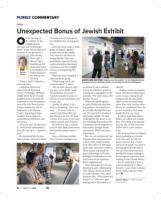
PHOTOS COURTESY CHUCK CLOUD PHOTOGRAPHY
ABOVE AND BOTTOM: Visitors tour the exhibit “In the Neighborhood:
Everyday Life on Hastings Street” at the Detroit Historical Museum.