

4 | JULY 4 • 2024
J
N
essay
Reflections on the Rebbe
I
met the Rebbe face-to-face
on Jan. 28, 1980. At that
time, I was the new 29-year-
old campaign director at the
Milwaukee Jewish Federation.
I remember it was a Monday
morning. A man named Marty
Stein, our cam-
paign chairman at
the time, marched
into my office and
said, “Drop what
you are doing.
We’re flying to
New York. You
will not need a
toothbrush.
” Marty had a force-
ful personality, and he was the
boss. I followed him out the
door.
The next thing I knew, I was
in Crown Heights, Brooklyn, at
770 Eastern Parkway standing
in a long reception line. Marty
whispered to me, “You are about
to meet the Rebbe.
”
At the time, I had only a
vague idea of who this man was,
and then the Rebbe handed me
a dollar and looked into my eyes.
Despite the many people in line
that day, I felt he was looking at
me as if I was the only person in
the room.
I was then yanked into an
over-crowded assembly hall
where thousands of Chasidim
seemed to be jumping up and
down on bleachers, waiting
for the Rebbe to speak. I later
found out that this was called a
“Farbrengen,
” which is a gath-
ering where the Rebbe would
share his Jewish wisdom and
insight. The Rebbe proceeded to
speak in Yiddish, which I didn’t
understand, for several hours.
With all the noise going on in
the room I couldn’t hear a single
word, although a Chasid stand-
ing next to me tried to translate.
I returned to Milwaukee that
same night exhausted and over-
whelmed. What I did not know
at the time was that my life was
about to be transformed.
Soon after I returned, I began
studying with Rabbi Israel
Shmotkin, the Chabad Shaliach
in Milwaukee. I began to search
for the meaning in my work
as a Jewish professional. From
that time forward, my career
as a Federation professional
developed alongside my desire
to grow as a Jew. The Rebbe and
the Shlichim who have shared
his teachings with me over the
years have made this search for
my Jewish self possible.
THE REBBE’S WORDS
In this essay, I would like to
describe in simple terms some of
the Rebbe’s teachings.
Perhaps, most importantly, I
have learned that every mitzvah
we perform creates an eter-
nal bond between a Jew and
Hashem. This is the essential
idea that has guided the estab-
lishment of the Rebbe’s emis-
saries, or Shlichim, around the
world. This teaching should also
inspire all of us who work in
the field of Jewish service. Quite
simply, the performing of a
mitzvah, or helping another Jew
perform a mitzvah, nurtures the
bond with Hashem and brings
positive spiritual energy into this
world.
According to the Rebbe, we
each have the responsibility of
sharing whatever Jewish knowl-
edge we possess with others.
This can be seen as an obliga-
tion, but it can also be seen as
a means to empower both our-
selves and those around us.
The Rebbe believed in the
power of positivity, both situa-
tionally and personally. As Jews,
especially these days, we often
focus on what is missing and
what we have lost. The Rebbe
teaches that we should always
focus instead on how to replace
that loss and how to grow from
it.
I am sure that if the Rebbe
could witness the antisemitism
taking place today his answer
would be that we must strength-
en our own Jewish identity.
The answer is not to ignore the
negativity around us but rather
to empower ourselves and our
children to grow as Jews.
The Rebbe believed in peo-
ple; he believed that people are
essentially good. He understood
that we all have weaknesses and
that we are all imperfect, but
that is not what defines us. The
Rebbe teaches that what defines
us is our “Neshama,
” our soul.
This is our essential goodness,
our true self. It is said of the
Rebbe that he saw the positive
potential in every person he met.
My wife, Lisa, and I now live
in Joshua Tree in the Hi-Mojave
Desert of California. There is no
organized Jewish community,
nor is there a Chabad shaliach.
Still, we study regularly with
Rabbi Avraham Susskind and his
wife, Leah, of Novi, Michigan, by
Zoom. Lisa performs the mitz-
vah of inviting Jews who live in
the area to Shabbat dinners and
holiday observances, including
our sukkah in the desert.
We have visited the Ohel, the
resting place of the Rebbe, on
several occasions and we return
there whenever we are in New
York. Lisa states, “It’s a place
where I feel like I belong.
”
We always feel a deep
personal connection with the
Rebbe during our visit and
return to our daily life with
renewed spiritual energy.
I met the Rebbe in person
on the 30th anniversary of his
assuming leadership of the
Chabad movement. Now I
write this piece to observe the
occasion of the Rebbe’s 30th
yahrzeit. It has been a personal
journey for me of 44 years. In
this time, my connection with
the Rebbe, his Shlichim and
my own spiritual search has
only grown. I feel grateful and
honored to be able to remember
the Rebbe today.
Robert Aronson is the former CEO of
the Jewish Federation of Detroit. For
more on the Rebbe and his legacy, see
the story on page 12.
Robert
Aronson
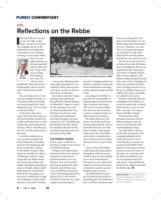
Robert Aronson (standing on far left) meets the Rebbe (center) in 1980.
PURELY COMMENTARY