

24 | JULY 4 • 2024
J
N
I
t’s not a pleasant prospect, but each of
us will eventually die. For family mem-
bers, the death of a loved one brings
sadness and a sense of loss but also a need
to deal with practical matters.
These include arrangements for a funeral
or memorial service, burial and shivahs —
decisions that must be made immediately.
Sometimes the person who dies has told
surviving family members or friends their
preferences about these issues, but often
that is not the case. Later, there is the need
to handle the deceased individual’s person-
al belongings that are not covered in a will
or trust.
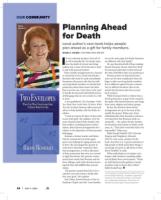
A new guidebook, Two Envelopes: What
You Want Your Loved Ones To Know When
You Die, by Rusty Rosman offers practical
advice to help families with the death of a
relative.
“I want to remove the layer of chaos that
occurs with grief,
” she explains. Over the
years, Rosman heard about families who
had conflicts, including heated confron-
tations, about funeral arrangements for a
relative or the disposition of their personal
belongings.
Rosman, a former teacher and Metro
Detroit commercial real estate agent,
spent years helping her aging parents and
in-laws. She encouraged her parents to
write down what they wanted for their
final arrangements, as well as allocation
of their possessions that were not covered
in legal documents. Her parents’ written
instructions meant that Rosman and her
three siblings could make decisions know-
ing that they had fulfilled their parents’
wishes.
“My parents wanted their kids to be a
cohesive unit and remain a family after
they were gone,
” she explains.
Josh Tobias, funeral director at the Ira
Kaufman Chapel, says that “most families
are on the same page, but family dynamics
are different with each family.
”
He says that about half of those making
funeral decisions choose what they think
the deceased individual would want and
the other half follow their own preferences.
Rosman points out that funeral deci-
sions can be more complicated when sib-
lings or other surviving family members
live in different regions because customs
vary in different locations. She recom-
mends that decisions take into account
local customs.
While Rosman’s book is written from a
Jewish perspective, as part of her research,
she spoke with funeral directors and clergy
from many religious and ethnic groups.
By law, the decisions about burial
arrangements are up to the next of kin,
usually the spouse, Tobias says. Some
individuals plan their funerals in advance,
covering items that Rosman’s book rec-
ommends — the casket, shivah, charities
for donations and number of death certifi-
cates, etc. “They don’t want their kids to be
responsible,
” Tobias says.
Rabbi Joseph Krakoff, CEO of Jewish
Hospice and Chaplaincy Network
(JHCN), who wrote a preface for the
book, describes it as “a great motivation to
help people to think about these things. I
encourage everyone to talk about it when
they’re healthy,
” he adds.
When individuals are in hospice care,
hospice staff members, including rabbis,
may facilitate these conversations. “When
an individual provides guidance, family
members want to honor their wishes,
”
Rabbi Krakoff says.
“Two Envelopes” by Rusty Rosman, published this year
by Front Edge Publishing, is available in paperback,
hardcover and e-book from Amazon, and through
some independent bookstores. The book is not
intended to provide legal or financial guidance.
Local author’s new book helps people
plan ahead as a gift for family members.
Planning Ahead
for Death
SHARI S. COHEN CONTRIBUTING WRITER
OUR COMMUNITY
Rusty
Rosman
RODNEY CURTIS