

4 | JUNE 27 • 2024
J
N
PURELY COMMENTARY
essay
Seeing Off a Fallen Soldier
I
srael is a small country.
Nearly everyone at the
appropriate age serves
in the military, nearly
everyone except in the haredi
and Arab sectors. But in
the secular,
national
religious,
Druze, and
other minority
communities,
and in many
Bedouin
communities,
nearly everyone serves in the
Israel Defense Forces. Now,
during the current ongoing
war, everyone knows soldiers
whose lives are at risk. The
bad news can come at any
time.
Most recently, the bad
news came to a family in
our neighborhood. Eliyahu
Moshe Shlomo Zimbalist was
killed in action on Friday,
June 14. His family lives at
the top of the street up the
hill from my home in Beit
Shemesh. I attend the same
synagogue as he did, as his
family does.
The burial took place the
afternoon of June 16 on Har
Herzl, the military cemetery
in Jerusalem.
The neighborhood has
a ritual to acknowledge
the death of a soldier from
among our people. Hundreds
of people come out to line
both sides of the street from
the family home toward the
road to Jerusalem. People
stand silently, many carrying
Israeli flags. Some sing,
quietly, softly, songs of hope
and faith:
“Our brothers, the whole
house of Israel, who are
placed in trouble, or in
captivity, whether on land
or at sea, may the One who
is present have mercy for
on them, and take them out
from trouble to freedom,
from darkness to light, and
from slavery to redemption,
now, quickly, and in near
time.”
And: “The soul is yours,
and the body is your work;
please protect your work.”
And: “In every generation,
they arise against us to
destroy us, but the holy
blessed One rescues us from
their hands.”
Caretakers from the
volunteer Hatzalah first
respondent group circulate
through the crowd,
identified by their vests
with the legend, “medic” or
“psychologist.”
More than a few in the
crowd sniffle quietly; a few
are audibly crying. One
soldier cannot seem to stop
crying. A medic comes over
and attends to his needs.
After some time, perhaps
a half hour, a neighbor
leads the soldiers toward
the family home. Then two
or three Hatzalah vehicles
come through the road, and
then the bus conveying the
family toward the cemetery
in Jerusalem pulls out.
The crowd parts to make
room for the bus, and then
quietly follows the bus for
the first few hundred meters
of its journey.
Louis Finkelman currently
resides in Beit Shemesh,
Israel. Until recently, he taught
literature and writing at Lawrence
Technological University in
Southfield, Michigan, and served
as half the rabbinic team at
Congregation Or Chadash in
Oak Park, Michigan.
Louis
Finkelman
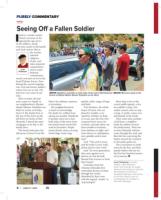
ABOVE: Neighbors assemble on both sides of the road in Beit Shemesh. BELOW: Mourners speak at the
funeral of Eliyahu Moshe Shlomo Zimbalist on Har Herzl.