

JUNE 13 • 2024 | 5
J
N
progressives who buy into
“intersectionality,” the idea
that all our causes interlock.
They say you cannot
demonstrate for women’s
rights or immigrants’ rights,
unless you accept all of our
causes, including opposition
to Zionism. Thus, other
people get to define Jewish
liberals as “not progressive
enough.” Even after touting
intersectionality, some
progressives openly tolerate
antisemites in leadership.
Apparently, concern for Jews
does not belong in “all of our
causes.”
Sniderman counts this
concern for human rights
for all minorities, but not for
Jews, as a classical form of
antisemitism. When Herzl
foresaw that Jews would
never be safe as a minority in
Europe, he understood that
we would need a national
homeland to be protected.
Anti-Zionists seek to
eliminate this, leaving
us no place of refuge or
safe haven. Many wish to
confound anti-Zionism as
anti-Israeli government,
hiding their antisemitism
behind a smokescreen.
People of color might
rightfully resent Jewish
bigots (as, alas, the Jewish
community does include
bigots). Some people of color
also resent Jewish allies,
who demonstrate against
racism (but who still seem to
have full white privilege) as
“white heroes,” as “limousine
liberals,” as people who
dabble in fighting oppression
as a hobby.
Many hold a view that
there is only privileged and
un-privileged; not realizing
that even in this there is
a hierarchy. While we are
“better off” than others, we
are still held rigidly in a caste
system and functioning as
a buffer between the lowest
economic/social groups and
those who truly hold the
power and privilege, in what
may be called a “buffer class.”
We are too white for these
critics, but not white enough
for white nationalists and
white supremacists. They
openly disdain Jews. If we
count as white to them, then
we are traitors to whiteness.
Those who would restrict
immigration often despise
Jews as generally supporting
asylum for refugees and
supporting lenient rules for
immigrants.
Political elites of all
varieties owe favors to their
financial backers. More
than a few of these financial
powerhouses earned their
fortunes in deals with
unscrupulous associates, with
criminals, enslavers, and with
notorious antisemites and
Nazis (not modern-day Nazis
but members of the Third
Reich power structure).
Sniderman views some
“legitimate” political leaders
with deep suspicion because
of their heritage and support
systems.
WHAT DO WE DO NOW?
Third point, the quandary:
What do we do now? We have
to get used to living in a more
hostile environment.
Would it help to bring
weapons to synagogues and
other soft targets where
Jews congregate? With his
background in the military
police, Sniderman says,
“Not at all, unless the people
carrying have undergone
thorough training and keep
up their training.”
While many feel they can
use weapons in threatening
situations, the actuality of
drawing and using a weapon
is a very difficult thing to
do; and that moment of
hesitation can be deadly. An
untrained carrier waving a
weapon probably would make
any tense situation worse.
A trained carrier knows not
to draw the weapon except
to use it, and then to use it
effectively.
Should we give up on
America? In the past two
or three years, impressive
numbers of Jews have moved
to Israel from England,
France and other European
countries. Moving to Israel
makes sense, according to
Sniderman, who identifies as
a Zionist and lived in Israel
for a year. Realistically, most
American Jews do not see
that as an option.
Do we turn to the people
who shared our political
dreams and try to re-enlist
them as our allies in the fight
against antisemitism? Yes, we
certainly should, but we have
to recognize that the political
landscape has shifted and
may shift more.
Some of the traditional
allies of liberal Jews now
define us as “other.” In our
times, many people defined
themselves by political
convictions. These identities
even replaced religious and
ethnic identity. When the
ground shifts beneath them,
and they are faced with
rejection from friends and
allies, it leaves them without
an identity.
Thousands of assimilated
Jews from Europe, in
particular, Germany, from
WWI to WWII, were full
citizens, yet within two to
three years were outcast. The
traditional political parties
do not necessarily provide
reliable safe havens, and the
people who share our ideals
may not share our concern
about the safety of Jews.
Sniderman emphasizes that
the discussion of whether
certain ideas qualify as
antisemitism should end
with the realization they are
just that. Further attempts
to educate, dialogue and
reason to bring others to
the idea that we are “like”
them is futile, self-deluding
and pointless (as well as
dangerous).
Last, it is time to
determine, as a community
what we can and should do
to deal with this reality. We
do not have time for lengthy
debate.
So, what do we do now?
Louis Finkelman currently resides
in Beit Shemesh, Israel. Until
recently, he taught literature and
writing at Lawrence Technological
University in Southfield, Michigan,
and served as half the rabbinic team
at Congregation Or Chadash in Oak
Park, Michigan.
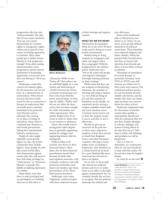
Gilbert Sniderman