

22 | JUNE 6 • 2024
J
N
D
etroit’s Hastings Street
neighborhood was home
to many members of the
city’s Jewish community from the
1880s through the 1920s. Jewish
institutions, stores and schools
served a Jewish community that
numbered 10,000 in 1910 and
increased to 75,000 by 1927,
according to Catherine Cangany,
Ph.D., executive director of
the Jewish Historical Society
of Michigan (JHSM), which
developed the current Hastings
Street exhibit at the Detroit
Historical Museum.
During Cangany’s research for
the exhibit, she searched local
newspapers for articles about the
Hastings Street Jewish community
during this era. Much to her
surprise, she found a Detroit News
article about a riot over kosher
meat prices in 1910.
“It literally fell in my lap,” she
says. Cangany told this story about
Jewish women’s efforts to combat
unfair kosher beef prices in a
lecture at the Detroit Historical
Museum on May 5.
Kosher meat is always more
expensive due to restrictions
that only certain parts of healthy,
unblemished animals can be
consumed. Extra processing
required for koshering meat also
adds to labor costs. But Cangany’s
research showed that in 1910,
kosher beef prices suddenly
increased 250% from $0.06 to $0.08
per pound to an astonishing $0.14
to $0.18 per pound for ground beef
and flank steak.
This was way too much for
many Jewish families. However,
Cangany says, the issue was
much broader than kosher meat
prices in Detroit. Beef prices were
manipulated by Chicago’s National
Packing Company, an unregulated
conglomerate of five U.S. meat-
packing plants that controlled
much of the U.S. meat market as
well as railroads that transported
cattle.
Some Jewish Detroiters turned
to other protein sources, Cangany
said, such as veal, chicken and
mutton, but the Beef Trust
controlled these as well.
Most Americans were unaware
of the conglomerate’s monopolistic
practices and their impact on meat
prices. In Detroit, Jewish women
blamed the city’s kosher butcher
shops, numbering almost 30. A
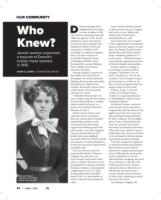
local woman — Rebecka Possner —
responded by organizing a boycott
of Detroit’s kosher meat markets.
Possner stated, according to
a newspaper account found by
Cangany: “Socialists? I do not
know what they are. We are not
socialists. We are simply trying to
get decent prices so that we can
live. I am not an agitator, but I am
going to help win this strike.”
Possner, at age 17, had led
a walk-out of young women
workers at a cigar manufacturer
in Philadelphia to achieve better
working conditions.
In Detroit, Possner convinced
many Jewish women not only to
forego kosher beef purchases at the
higher prices but also to prevent
this meat from being purchased
by those willing to pay the higher
prices. Some of their purchased
meat was seized by the women
boycotters and doused in kerosene.
When that tactic failed to stop all
kosher beef sales, the boycott led to
a riot, fortunately without injuries
and minimal property damage.
Then the community organized
co-operative kosher meat markets
that sold beef at rates midway
between the original and increased
prices. Although the meat quality
wasn’t as good and it was not
deboned before weighing, the lower
price resulted in a sell-out of all
2,200 pounds of stock. Possner
expressed concern about the riot
but felt that the boycott was a
success. Similar events occurred
in other cities, following an earlier
boycott in New York.
According to Cangany, the
Jewish women organized
a boycott of Detroit’s
kosher meat markets
in 1910.
Who
Knew?
SHARI S. COHEN CONTRIBUTING WRITER
OUR COMMUNITY
Rebecka Possner,
organizer of the 1910
kosher meat boycott
COURTESY ARCHIVES OF MICHIGAN. RETOUCHED BY JHSM.