

MAY 23 • 2024 | 23
not welcome in Jewish settings.
Health & Human Services &
Financial Well-being
• 23% of Jewish households
include someone with a chron-
ic health issue, special needs or
disability.
• One in six households say
they are struggling financially.
WHAT’S NEXT
While the study itself is com-
plete, the community’s work
to translate data into action
is just beginning. This report
is the starting point for intro-
spection, deeper conversation
and collaborative strategic
planning.
A Community Visioning
and Strategic Planning
Committee, chaired by Robin
Pollak and Megan Bernard,
has begun to meet to develop
a new community vision and
strategic plan. This plan will be
generated over the course of
many months, using the valid
data of the study as a founda-
tion to identify a set of com-
munal values and goals, and a
strategic plan to enhance local
Jewish life.
The planning process will be
conducted in partnership with
volunteer leaders, community
organizations, program pro-
viders and the community writ
large to explore the data, iden-
tify new questions and contin-
ue to learn about communal
needs and desires.
Federation Board President
Decky Alexander emphasizes
that the next steps are a neces-
sary continuation of the pro-
cess started by the study. “
As
with other communities across
the U.S. who have engaged in
data-driven planning, I hope
that the study gives us, if not
a roadmap, a light on how to
best engage, serve and support
each other now and in the
future,” she says.
THE PLAYERS
A diverse group of over 60
volunteer and profession-
al leaders served on the
Community Study Planning,
Implementation and Next
Steps Committees, chaired by
Barry Nemon and co-chaired
by Randy Milgrom.
The research team was a
collaboration of two preemi-
nent research institutions: the
Cohen Center for Modern
Jewish Studies (CMJS) at
Brandeis University and
NORC at the University of
Chicago. This team, led by Dr.
Janet Aronson and Professor
Leonard Saxe at Brandeis
University, and Dr. David
Dutwin and Evan Herring-
Nathan at NORC, combined
CMJS’s extensive experience
conducting dozens of Jewish
community studies over the
last two decades with NORC’s
expertise using the most
advanced research methodol-
ogies.
This study was made possi-
ble by the foresight and stra-
tegic vision of directors of the
Jewish Federation of Greater
Ann Arbor, which recognized
the importance of convening
this project, and by the com-
munity partner organizations
who understood how crucial
this data and analysis would
be, and will be, to the future of
our community.
Generous financial sup-
port was received from Beth
Israel Congregation, JCC of
Greater Ann Arbor, Jewish
Community Foundation of
Greater Ann Arbor, Jewish
Family Services of Washtenaw
County, Jewish Federations of
North America and Temple
Beth Emeth. The Harry and
Jeanette Weinberg Foundation
provided a significant grant to
understand the racial and eth-
nic diversity of our community
and to collect data about finan-
cial insecurity.
Additionally, the follow-
ing communal organizations
provided valuable input and
encouragement through-
out this process: Ann Arbor
Orthodox Minyan, Ann
Arbor Reconstructionist
Congregation, Chabad House
of Ann Arbor, Hebrew Day
School of Ann Arbor, Jewish
Communal Leadership
Program at U-M, Jewish
Cultural Society and Pardes
Hannah.
Finally, this study would not
have been possible without the
participation of the over 900
households who responded to
the survey to provide data on
a diverse and thriving Jewish
community in Washtenaw
County.
Eileen Freed is CEO of the Jewish
Federation of Greater Ann Arbor. The
full Community Study and a document
containing major highlights are
available at www.jewishannarbor.org/
communitystudy. For more information,
contact Eileen Freed at eileenfreed@
jewishannarbor.org.
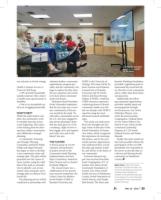
Community members
listen to the results
of the study.