

16 | MAY 23 • 2024
J
N
A
s a sharp increase of campus
antisemitism continues to disrupt
college life for Jewish students
and, most recently, commencement cer-
emonies, including at the University of
Michigan, Jewish students are left feeling
frustrated, scared and wondering if they’re
truly safe in educational institutions — or if
these universities have failed them.
Detroit native and foreign policy expert
Harley Lippman, who serves as an execu-
tive committee member on the American
Israel Public Affairs Committee (AIPAC)
and as a member of the U.S. Commission
for the Preservation of America’s Heritage
Abroad, believes universities aren’t doing
enough to protect Jewish students.
“It’s a combination of things,
” the Jewish
adviser to the Biden administration told
the Jewish News. Lippman, who has been
instrumental in talks between Palestinians
and Israelis, offers a few reasons why
broader geopolitical dynamics are influenc-
ing local campus life.
CONTRIBUTING FACTORS
The first reason, he says, is the source of
funding received by universities.
According to a 2022 study, Qatar con-
tributed a reported $4.7 billion to aca-
demic institutions across the United States
between 2001 and 2021. “Departments
have been bought and collected by a huge
influx of radical Islamic money,
” Lippman
explains.
Lippman believes the funding has
played a role in what he calls “a failure” of
American universities in keeping Jewish
students safe. The second contributing
factor, he says, is a simmering antisemitism
that has persisted since the Holocaust,
although it may not have been seen and felt
as strongly throughout the decades as it has
in recent years.
“We like to think it just went into hiber-
nation,
” he says. “Yet in the last few years,
just think of the massacre at the Tree of Life
Congregation in Pennsylvania [that claimed
the lives of 11 individuals].
”
With antisemitism never truly gone,
Lippman says today’s stark rise of anti-
Jewish sentiment, especially on campus life,
is the worst in recent memory.
Now, a global outpour of outrage toward
Jewish individuals as a result of the ongoing
conflict in Gaza has only perpetuated what
was already there, he adds.
Still, a third reason for increased cam-
pus antisemitism is the influence of what
he calls “professional agitators,
” or people
trained to effectively mobilize students at
universities, Lippman continues.
These professionals, he says, have the
ability to set up camps and influence
campus dialogue. “They don’t know what
‘from the river to the sea’ is, but that doesn’t
make them any less dangerous,
” Lippman
describes. “They are extremely dangerous.
”
With many protestors wearing masks,
Lippman likens them to the KKK, or Ku
Klux Klan, one of the only other groups in
U.S. history that wore masks while demon-
strating.
“It’s very disturbing and menacing when
students have masks on because it allows
outsiders to infiltrate,
” he explains of exter-
nal influence on campus protests against
Jewish students and the ongoing Israel-
Hamas war. “You don’t recognize people.
”
PUTTING AN END TO HATE
Lippman, who is on the Yale School of
Management Board of Advisors and a
member of the Dean’s Advisory Board at
Columbia University’s Graduate School of
International and Public Affairs, has wit-
nessed firsthand how campus life has been
uprooted.
“It creates a very intimidating atmo-
sphere on campuses,
” says Lippman, who
speaks on the issue worldwide. While it
may seem like events are only worsening
for U.S. Jewish college students, Lippman
says there is hope for change and action
that can be taken.
“Contact the Human Rights Commission
to open an investigation into discrimi-
nation and harassment complaints from
Jewish students at Michigan universities,
”
he suggests. “That’s what needs to be done
and to follow up to make sure it’s done.
”
Jewish community members can also
“contact the Michigan Department of
Attorney General and insist they use their
full authority under civil rights laws to look
at any institutional failures that enable or
have given inadequate responses to antise-
mitic acts and hostile environments for
Jewish students,
” he added.
Lastly, on a federal level, Michiganders
can “urge the U.S. Department of
Education to move swiftly to investigate
Title VI prohibitions on discrimination
based on race or national origin as it relates
to antisemitism targeting Jewish students,
”
Lippman advises.
“It looks very dark and bleak now,
” he
says, “but I think it’s an opportunity for us
to educate the world once and for all that
Israel’s a legitimate nation.
”
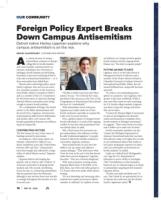
Detroit native Harley Lippman explains why
campus antisemitism is on the rise.
Foreign Policy Expert Breaks
Down Campus Antisemitism
ASHLEY ZLATOPOLSKY CONTRIBUTING WRITER
OUR COMMUNITY
Harley
Lippman
ARE YOU A