

MAY 2 • 2024 | 39
J
N
I
met Dieter Sander in early September
2022, when two stolpersteine for Frieda
Goldstein and her son Samuel were
installed in Berlin. Small brass markers,
or “stumbling stones,
” are
embedded in sidewalks at
the addresses where Nazi
victims had last lived. These
two at Fehrbellinerstrae 19
help to swell the numbers of
a crowd-sourced memorial
project, now counting over
80,000 individual markers
spreading over 24 countries.
My ties to the Goldsteins, whose stones I
had sponsored, began by chance. During a
2012 trip with students to study Holocaust
memorials in Germany, our response to
stumbling upon brass markers all over the
city prompted a desire to retrieve from dark
forgetfulness one or two Jewish victims,
preferably who had last lived near our
Rosenthaler Platz hostel. We chose Frieda
Goldstein’s name from a 1938 address book.
Ten years later, I was in Berlin for the
installation and to continue tracing the
stories of Frieda and her son Samuel in
archives and across the landscapes of
Germany, Poland and England. Here are
the inscriptions on the stolpersteine:
Hier Wohnte [Here Lived]
Frieda Goldstein
Jg. 1871 [Born]
Deportiert 24.10.1941 [Deported]
Lodz
Ermordet 15.5.1942 [Murdered]
Kulmhof [Chelmno]
Hier Wohnte [Here Lived]
Samuel Goldstein
Geb 1902 [Born]
Flucht [Escape] 1939
England
This bare summary tells us nothing of
their lives after birth, except the resolutions
of their Holocaust experiences. Both were
born in the town of Oświęcim, its Polish
name now overshadowed by the German
renaming as Auschwitz. I learned that the
entire Goldstein family, parents and five
children, had moved to Berlin in 1920,
where Samuel became a dentist. By the
summer of 1939, after his other siblings
had fled Germany, he and Frieda shared
an apartment on Fehrbellinerstrae. Then
the fates of this Jewish mother and son
diverged.
Samuel escaped to England just seven
weeks before the war began and found
refuge in Kitchener Camp on the Kentish
coast where some 4,000 young Jewish men
from Germany and Austria were sheltered.
Frieda remained in Berlin until October
1941, when she was deported back to
Poland and confined in the Łodz ghetto.
Seven months later, she was murdered in
the gas vans at Chelmno.
Our a short ceremony in 2022 at
Fehrbellinerstrae was rather austere. None
of the five surviving Goldstein siblings
had descendants, and there were only six
non-relatives in attendance. I could tell that
Dieter was disappointed in the rushed time
schedule and the spareness of the event. So,
he took my wife and me under his wing for
the day, showing us stolpersteine that he
had supervised in the area. Then at a café
on Shoenhauser Alle, already crowded with
young people beginning their late-summer
weekend, he invited us to attend another
stolpersteine event outside the Helene-
Haeusler-Schule on Mendelssohnstrae, so
we could “see how it should be done.
” There
would be music, he said, including a song
made famous by Marlene Dietrich, “Sag
mir, wo die Blumen sind.”
Basking in the intense late-summer sun
and sipping an excellent weiss kristall beer,
I wondered about the appropriateness of
using a Dietrich song at such a moment.
But the pleasures of the afternoon, the sun
and the effervescent kristall distracted me.
I did not later research the school where
the ceremony would be held. Dieter had
emphasized the participation of students,
but I assumed it would be the typical kind
of community project so common in public
schools today.
A SPECIAL CEREMONY
AT A SPECIAL SCHOOL
On the day of the ceremony, I arrived just
in time at Mendelssohnstrae 10. It was no
small feat to dash by S-Bahn and tram from
the Landesarchiv on the city’s far northwest-
ern edge to its center in under 40 minutes.
After negotiating the chaotic Mollstrae,
a busy four-lane road with bright yellow
trams speeding down its center, I made my
way to what seemed an unlikely location for
a school. A ten-story apartment building
dominated its street. Apartments looming
over me, I rushed up Mendelssohnstrae to
continued on page 40
Robert
Franciosi
Special to the
Jewish News
YOM HASHOAH
Shining
Stones,
Fading
Hopes
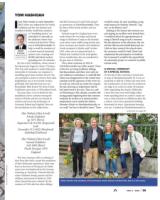
Dieter Sander and members of the Horowicz family. Rachel of Kibutz Kfar Aza is in the center.
PHOTOS BY ROBERT FRANCIOSI