

8 | APRIL 4 • 2024
J
N
T
he presence of over a
million Gazan civil-
ians in the Rafah area
serves as a kind of “armor” for
Hamas’ remaining battalions in
southern Gaza,
which is why any
Israel Defense
Forces operation
aimed at taking
control of this
last bastion of
the terror group
must begin with
the evacuation of civilians.
In order for the Israel
Defense Forces to be able oper-
ate freely in Rafah, the civilians
there will have to evacuate —
and Hamas will do everything
in its power to prevent them
from doing so for precisely this
reason.
Since the start of the war,
some 1.5 million Gazans, most
of them from northern Gaza
and Gaza City, complied with
IDF calls to evacuate to the
south.
The IDF’s Southern
Command and its Population
Evacuation Unit possess a state-
of-the-art control center and
real-time map of Gaza’s civilian
situation, enabling evacuation
from specific areas and the
tracking of those efforts.
By December, the IDF was
able to evacuate over a million
people from northern Gaza,
including 850,000 from Gaza
City — setting a vital prece-
dent.
The IDF uses an array of
means to communicate evacu-
ation requests to Gaza civilians,
including phones calls, text
messages, flyers, loudspeakers
and social media platforms.
During these past evacua-
tion efforts, the IDF witnessed
many attempts by Hamas to
stop Palestinian civilians from
leaving, with the terrorists then
using every possible human-
shield tactic imaginable, such
as firing on Israeli forces from
hospital wards or family living
rooms.
The difference this time will
be that now, the IDF will need
to set up checkpoints to filter
out any terrorists attempting to
move north with the civilians,
with or without Israeli hostages.
Such a filter was not required
at the start of the ground offen-
sive on Oct. 27, enabling many
terrorists to flee to Rafah from
other parts of Gaza, possibly
taking hostages with them.
Currently, the IDF complete-
ly surrounds Rafah, and Hamas
forces there will not be able to
escape.
It seems reasonable to assess,
based on past evacuation
efforts, that it will take two to
three weeks to complete the
Rafah evacuation efforts, which
would see civilians move to
new safe zones, potentially
in Al-Mawasi, west of Khan
Yunis, and in new locations
along the central and southern
Gazan coastline.
Currently, most Gaza civil-
ians are located in Rafah, in the
Mawasi safe zone and in Dir
al-Balah in central Gaza.
After the Rafah evacuation
is complete, combat there will
likely resemble that in other
parts of Gaza, as the IDF will
be engaging a large concentra-
tion of terrorists — both the
four remaining Hamas bat-
talions and the terrorists who
joined them from northern
Gaza.
Two barely functioning
Hamas battalions are also
active in central Gaza’s Nuseirat
and Dir Al-Balah areas.
The IDF’s Division 98, which
is leading the combat in south-
ern Gaza, will command the
Rafah stage of the war, and
will likely receive significant
reinforcements from additional
brigades for this mission.
The past six months have
demonstrated that the IDF has
the ability to conduct a large-
scale operation in Rafah and to
evacuate civilians, but this time,
once the order is given, military
planners and field commanders
will face new operational
challenges.
Yaakov Lappin is an Israel-based mili-
tary affairs correspondent and analyst.
He is the in-house analyst at the Miryam
Institute; a research associate at the
Alma Research and Education Center;
and a research associate at the Begin-
Sadat Center for Strategic Studies at
Bar-Ilan University. He is a frequent
guest commentator on international
television news networks, including Sky
News and i24 News. Lappin is the author
of Virtual Caliphate: Exposing the Islamist
State on the Internet. Follow him at: www.
patreon.com/yaakovlappin.
PURELY COMMENTARY
Yaakov
Lappin
jns.org
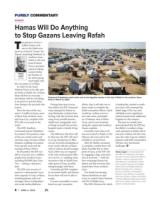
Displaced Palestinians pitch tents next to the Egyptian border in the city of Rafah in the southern Gaza
Strip on March 8, 2024.
analysis
Hamas Will Do Anything
to Stop Gazans Leaving Rafah
ABED RAHIM KHATIB/FLASH90