

10 | MARCH 28 • 2024
J
N
continued from page 9
Lucille Ball of our time,” noting her
Emmy Award for her role in Will
and Grace, one of the first network
television show with openly gay
characters.
Messing, making her first visit to
Detroit, grew up in Rhode Island. Her
parents were observant Jews active in
the local Jewish federation, but she was
one of only three Jews in her school.
In second grade, she was told to “get
to the back of the line, kike,” and it
was then that she started to believe
being Jewish was something bad, even
though she didn’t understand exactly
what ”kike” meant. One Halloween,
her grandfather’s car was defaced with
swastikas. She began to think being
Jewish could be dangerous and started
to downplay her Jewish identity.
That changed after she attended
Brandeis University. “For the first time,
I felt safe,” she said. “I didn’t have to
explain what it meant to be Jewish.” She
went on to New York University for a
master’s degree in acting.
She was just finishing a role in a live
play when she was offered the role of
Grace Adler. She almost turned it down
because she felt she needed a break.
Then, she said, she read the script and
realized how special the show was,
with a Jewish character that wasn’t a
stereotype and a chance to be the first
Jewish leading lady on television in
decades.
The show ran for 11 seasons.
STANDING UP FOR ISRAEL
Messing spent many years working on
behalf of groups she felt were being
treated disrespectfully, including
women, Muslims, people of color,
people with AIDS and more. No one
from these groups showed up for the
Jewish victims after Oct. 7. “The silence
was devastating,” she said.
Shortly after Oct. 7, she spoke at
the nationwide pro-Israel rally in
Washington, D.C.
Addressing the crowd of 300,000 was
intimidating. “I was very scared,” she
said. It was not what she had trained
for, but, quoting the Jewish sage Hillel,
she added, “If not now, when?” When
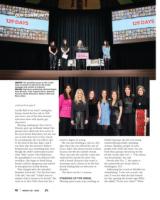
ABOVE: The panelists pause as the crowd
held a moment of silence for the Israeli
hostages and victims of violence.
BELOW: Signature Leadership: Sherrie Singer,
Amy Berman, Julie Trepeck Harris, Stefanie
Aronow, Shelly Rubenfire, Melissa Wolf and
Nancy Glen.
OUR COMMUNITY