

MARCH 21 • 2024 | 27
J
N
B
atyah and Yehudah Hertz of
Huntington Woods look for-
ward to Shabbat with their kids
Avi, 6, Shayna, 4, and Yonah, 2, every
week. It’s a time when they don’t take
out their phones or use electronics, and
they don’t cook. They have rules around
what they can carry and where.
This kind of Shabbat practice is
something they’ve incorporated into
their lives as adults, says Batyah
Hertz, explaining that it all started at a
Simchat Torah auction at The Shul in
West Bloomfield. They pledged to keep
Shabbat for 25 hours one week, and that
February, fulfilled their pledge, starting
by lighting candles before sunset.
“We decided to keep Shabbos with
Rabbi Pinson and his family. We had
Shabbos; it was great,” she says. “Then
that week, we were talking. We said,
‘Why don’t we keep Shabbos again?’
and that was the catalyst. We’ve kept
Shabbos ever since, and it’s been 10
years.”
Before COVID, they’d have compa-
ny for Shabbat more often, but during
the pandemic decided to isolate more
strictly. Then, as the days all blended
together and there was so much uncer-
tainty, she says, they again found com-
fort in Shabbat.
“Shabbos became a real beacon in our
week, something to look forward to,”
she explains. “I know that on Shabbat, it
will just be our family. We have no dis-
tractions from listening to the news or
the next horrible thing that’s happening.
There’s kind of this peace and tranquil-
ity that it’s coming and that there’ll be
this reprieve.”
Having the placeholder in the week
is important for her family’s well-being,
she says. “Not only for our physical and
our spiritual health, but also for our
family and our marriage, so it’s been a
real blessing for us,” she explains.
At the same time, it can be hard, she
adds. “With all the good, it can be real-
ly stressful not knowing what email is
going to be in my inbox when Shabbos
is over or what world event is happen-
ing.”
On Fridays, the kids get home early
from school and clean up their toys,
putting their noisy battery-operated
books and electronics away. She cooks
in the afternoon and focuses on helping
her family have a peaceful entry into
Shabbat.
“In the beginning, I felt very stressed
all the time, ‘Oh, my gosh, Shabbos is
comingr — run, run, run.’ The last year
or so, I’ve really tried to focus on what’s
really important about Shabbos, and
having a perfectly clean house and per-
fectly clean children is maybe not the
most important thing.”
Hertz says she likes to cook tradi-
tional food such as soup, gefilte fish
and herring. Her 6-year-old also helps
prepare the herring, which he loves.
When she makes challah, the kids get
to decorate the extra dough for challahs
for their plates, too. “That’s special for
them,” she says.
Overall, Hertz explains, she likes
that they can sit around as a family
after lighting candles. Then they’ll sing
songs, make Kiddush and have challah.
Even when they have guests over, it’s
a priority to make sure the kids have a
place at the Shabbos table, she explains.
“They participate, and they share about
what they learned at school that week,
and they’re part of the conversation, so
that’s really important to me.”
Hertz adds that she hopes her kids
also learn to value Shabbat as a time
of connection and rest, and to see the
many gifts it offers, including lessons
about inner resources and healthy
boundaries. “I have the same issues. I
want to look this thing up on Shabbos. I
can’t Google whatever idea I have in my
head this minute. I have to wait,” she
says. “It’s hard to delay gratification.”
Ultimately, she says that she’s grate-
ful for the chance to slow down and
connect. “Shabbos gives us a frame-
work for our week and our life,” she
says. “And to have that rhythm is really
important.”
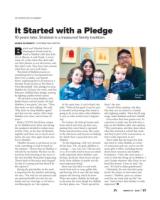
10 years later, Shabbat is a treasured family tradition.
It Started with a Pledge
KAREN SCHWARTZ CONTRIBUTING WRITER
CELEBRATING SHABBAT
The Hertz
Family