

8 | MARCH 7 • 2024
J
N
PURELY COMMENTARY
essay
The Crazy, Delusional, Surreal State
of Being Israelis in the Aftermath of Oct. 7
T
here is no exact
equivalent word in
English to describe
the Hebrew word hazui. A
combination of
crazy, surreal
and delusional
is the closest
to convey
the feeling of
its meaning.
This word was
used in almost
every conversation I have
had with family, friends and
other people I met in Israel
recently. It also describes
the disbelief and utter post-
traumatic feelings that most
Israelis have experienced
since Oct. 7.
On that morning, we
all woke up to one of the
most horrific and brutal
historical attacks on the
Jewish state and Jews
all over the world. Since
that event, the worldwide
Jewish community has
been suffering increased
antisemitism.
As someone born in Israel
and a son of Holocaust
survivors, I felt violated yet
again. I needed to go there to
be with my family and fellow
Israelis to do something to
help in the national effort to
recover.
I spent close to four weeks
in this amazing, wounded
country. The experiences I
had left me with a greater
sense of awe as well as
concern for my homeland. I
don’t want anyone to believe
I fully support the actions of
the Israeli government pre-
and post-Oct. 7; however,
there is no doubt in my mind
that the mere existence of
Israel is vital not only for
Israelis but also for Jews
worldwide.
I started my volunteer
work at a depot that
gathered donated clothing,
food, furniture and other
household items earmarked
for the displaced families
from the Gaza and Lebanon
borders. Though the place
was packed with items,
few came to take any. The
evacuees and victims are still
in a state of limbo. Wanting
to give them what they need
requires more than the stuff
at that center.
I then began helping
prepare warm meals for
Israeli soldiers in both the
northern and southern
fronts. I was working in a
kitchen at Jack’s Inn (in Kefar
Nechamia) doing whatever
was needed. I did everything
from cutting vegetables
and chicken into pieces
to seasoning and stuffing
potatoes with meat patties to
just cleaning up and washing
dishes. This kitchen ships its
prepared food to the soldiers
as well as sends a food truck
on a biweekly basis to the
border to make soups and
pizzas for soldiers at their
bases. My most significant
experience was to join one
such excursion close to the
Lebanese border.
For me, it was coming
full circle because we
served artillery troops using
modern versions of the
same cannons I used in my
military service at the very
same front. I felt like I was
serving a younger version of
myself.
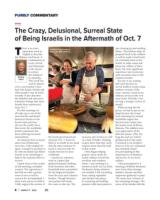
While serving the hot
pizzas, we had to put on ear
plugs because the troops
were returning fire toward
Hezbollah targets that
had just sent rockets into
the nearby town of Kiryat
Shmona. The soldiers were
very appreciative of the
delicious pizzas. After the
long day and our vehicle
getting stuck in the mud,
I returned to my brother’s
house at 3:30 a.m. exhausted
but extremely elated
for participating in this
important act of kindness
and service to our brave
soldiers.
I also participated in a
meeting at Kibbutz Ruchama
near Gaza where hostage
families, friends and their
supporters gathered to plant
136 carob trees in honor of
the remaining hostages. The
stress of the families felt like
Avishay
Hayut
Avishay Hayut making
pizzas for IDF soldiers.