

Looking Back
From the William Davidson Digital Archive of Jewish Detroit History
accessible at thejewishnews.com
62 | FEBRUARY 29 • 2024
J
N
When Zionists
Were Welcomed
I
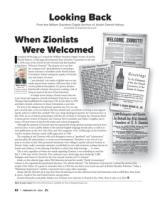
t jumped off the page as I cruised the William Davidson Digital Archive of Jewish
Detroit History. A half-page advertisement from Chrysler Corporation in the July
1, 1938, issue of the Detroit Jewish Chronicle had this headline
in big letters: “Welcome Zionists!” The ad goes on to say that
the company took “great pleasure in extending a
hearty welcome to members of the World Zionist
Convention,
” before touting the quality of Chrysler
cars and trucks, of course.
I was shocked. Any reader of global news or just
media reports from America will know that, in the
current political atmosphere, if a person declares
him/herself a Zionist, that person is taking a risk of
being accused of all sorts of bad intentions.
In simple terms, being a Zionist means that one
is pro-Israel and supports a Jewish homeland. It has been so since
Theodor Herzl published Der Judenstaat (The Jewish State) in 1897
and held a Zionist conference in Basel, Switzerland, a year later.
For Jews in the diaspora, the primary question was: Do you sup-
port a Jewish state, or do you believe that Jews should only concentrate on living in and support-
ing the nation in which they resided? This was a huge ideological question for American Jews in
the 1930s, an era of intense antisemitism with the rise of Nazis in Germany, the American Bund
(a home-grown version of Nazism), the America First Committee and Father Coughlin, just to
name a few purveyors of anti-Jewish tropes and vicious propaganda.
Although the question of Zionism may have generated strong opinions among American Jews
and non-Jews, it was a public debate in the national English-language Jewish press, as well as in
such publications as the New York Times and Time magazine. Over 12,000 pages in the Davidson
Archive mention Zionism; nearly 3,000 pages prior to 1940.
The coupling of anti-Zionism with such derogatory terms as “apartheid” and “colonization,
”
and just plain old antisemitism, is a more recent development. Therefore, it was a bit of a sur-
prise to see that, in July 1938, prominent businesses were willing to openly welcome Zionists to
Detroit. Today, sadly, convention attendees would likely be met with protesters, perhaps threats of
bombs and violence, or the defacing of facilities in which they held meetings … or worse.
This is why, regardless of where one stands regarding Zionism, it was refreshing to read the
July 1, 1938, issue of the Chronicle. The conference was a front-page story declaring “1,000
Delegates and Guests in Detroit for the 41st Annual Conclave of U.S. Zionists.
”
Inside, on the editorial page, editor Phil Slomovitz devoted his weekly “Purely Commentary”
column to the organization’s presidential elections. The official editorial, “The Palestinian ‘Experiment,
” is about the merits of the
people of the Yishuv (it is good to remember that, in 1938, the area that is now Israel was part of British-Mandate Palestine). Today, a
“Palestinian Experiment” could be construed to have many other meanings.
Along with the Chrysler ad, it must have been heartening to see the welcomes from local businesses such as E&B Beer, Moe Leiter
& Assoc., Snyder’s Pies and United Dairies, among others.
Zionists themselves and public debates over Zionism were welcome in Detroit in the 1930s. Were it only so in 2024.
Want to learn more? Go to the DJN archives, available for free at thejewishnews.com.
Mike Smith
Alene and
Graham Landau
Archivist Chair
ing the nation in which they resided? This was a huge ideological question for American Jews in
the 1930s, an era of intense antisemitism with the rise of Nazis in Germany, the American Bund
Although the question of Zionism may have generated strong opinions among American Jews
magazine. Over 12,000 pages in the Davidson
Detroit. Today, sadly, convention attendees would likely be met with protesters, perhaps threats of
column to the organization’s presidential elections. The official editorial, “The Palestinian ‘Experiment,
” is about the merits of the
people of the Yishuv (it is good to remember that, in 1938, the area that is now Israel was part of British-Mandate Palestine). Today, a
ing the nation in which they resided? This was a huge ideological question for American Jews in
the 1930s, an era of intense antisemitism with the rise of Nazis in Germany, the American Bund
Detroit History. A half-page advertisement from Chrysler Corporation in the July
had this headline
Convention,
” before touting the quality of Chrysler
I was shocked. Any reader of global news or just
media reports from America will know that, in the
him/herself a Zionist, that person is taking a risk of
In simple terms, being a Zionist means that one
is pro-Israel and supports a Jewish homeland. It has been so since
) in 1897
For Jews in the diaspora, the primary question was: Do you sup-
port a Jewish state, or do you believe that Jews should only concentrate on living in and support-
port a Jewish state, or do you believe that Jews should only concentrate on living in and support-
port a Jewish state, or do you believe that Jews should only concentrate on living in and support-