

36 | FEBRUARY 29 • 2024
J
N
L
et me begin by introducing
myself. I’m a new regular
writer for the Detroit Jewish
News, and I’m excited that each
month I’ll be sharing recipes that
I’ve vetted. Don’t hesitate to reach
out if there are par-
ticular recipes you
would like to see.
While it’s still a
few weeks away,
before you know it,
Purim will be here.
The holiday of
Purim is associated
with several food-
based mitzvot, including giving
gifts of food and enjoying a festive
meal on Purim afternoon, as well
as a number of traditional foods.
While hamantashen are the
most ubiquitous Purim food
here in the U.S., they are cer-
tainly not the only one. Other
traditional foods from around
the world are characterized by a
few key themes: representations
of Haman, the holiday’s villain;
foods with hidden fillings, rep-
resenting the hidden identities
that exist in the Purim story; and
foods with legumes and seeds,
representing the diet of Esther,
the holiday’s heroine, who, legend
has it, was trying to maintain her
observance of Jewish dietary laws
while also concealing her Jewish
identity.
This legend of Esther really
resonated with me, especially
in these current times. Food
is a source of nutrition, but it
is also a representation of our
identity, both in private and in
public. In college, I lived abroad
for a semester in Brussels and a
semester in Hong Kong. Keeping
kashrut during those journeys
meant that I couldn’t eat all the
local delicacies, and it was a con-
stant reminder to myself that I
was different and, in particular,
that I was Jewish. While it wasn’t
always convenient to make my
way across the city on public
transportation to procure kosher
meat, it reminded me and those
around me of who I was.
In recent months, we’ve seen
an increase in antisemitic acts,
which Jews have responded to in
different ways. On the one hand,
we might feel empowered to
publicly show our Jewish identity
by wearing kippot or Jewish star
necklaces or other items. On the
other hand, we might feel that it
is not safe to do so. Both of these
feelings are valid, and we can per-
haps look to Esther as a model for
how to balance these competing
feelings.
In honor of Esther, I share a
number of legume- and seed-
based recipes. I hope you are able
to enjoy these recipes and reflect
on how your choices reflect your
identity and what that means for
how you want to be seen in the
world. I also hope they provide a
nice balance to any abundance of
hamantashen you might be enjoy-
ing for the holiday!
CREAMY LENTIL
VEGETABLE SOUP
Adapted from Beth Moncel,
Budget Bytes
Makes 4 servings
Pareve
Ingredients
16 oz. mushrooms, rinsed and thickly
sliced
2 tbsp. cooking oil
3 carrots, diced
3 ribs celery, diced
1 yellow onion, diced
2 cloves garlic, minced
½ tsp. dried thyme
½ tsp. rubbed sage
½ tsp. dried rosemary
1 c. brown lentils
3 c. vegetable broth
1 (13.5-oz.) can full-fat coconut milk
Salt and pepper to taste
Instructions
Add the mushrooms to a large
soup pot or Dutch oven along
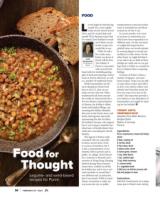
Legume- and seed-based
recipes for Purim.
Food for
Thought
Joelle
Abramowitz
Contributing
Writer
FOOD