

10 | FEBRUARY 29 • 2024 J
N
essay
Returning to Israel
I
n August of 2023, I was on
a Fact Finders trip to Israel
with Michigan State students,
Jewish and non-Jewish alike,
to learn about the conflict on
the ground in Israel. We spent
time in the Gaza Envelope
region, specifically Sderot and
Kfar Aza. In Sderot, we visited
a playground made up almost
completely of bomb shelters; in
Kfar Aza, we talked to a resident
who explained what life was like
in the kibbutz and showed us
rockets that landed there.
After we left the area, I
thought I had a good grasp on
the situation. Being so close
to Gaza, I saw how the people
had adapted to the daily threat
of rockets from Hamas. But,
they adapted and were thriving
regardless. I left Israel thinking
things were OK. Then Oct. 7
happened.
I, along with the world,
watched the initial reports of
the Hamas invasion in horror. I
watched the news and texted my
Israeli friends and family con-
stantly, trying to validate their
safety. And as more information
was released, I felt more and
more helpless.
I planned events for discussion
and reflection on campus, and I
took to social media to keep peo-
ple informed, but no matter what
I did, the feeling of helplessness
persisted. So, when I was offered
an opportunity to return to Israel
for a wartime variation of the
Fact Finders trip, I had to say yes.
ON THE GROUND
Our first stop was Hostage
Square in Tel Aviv. I had seen
images online, specifically of
the Shabbat table with a seat
for every hostage. It took over
a minute to walk just one side
of the table from end to end. It’s
impossible to capture the sheer
magnitude of a table set for over
200 people through photographs
or videos.
In the following days, we
heard from a variety of speakers
about the geopolitical situation
after Oct 7. We met survivors of
the Nova Festival and families of
the hostages. We met physicians
and first responders, including a
ZAKA volunteer whose recollec-
tions will haunt me for the rest
of my life.
But we didn’t just hear stories;
we witnessed the aftermath of
Oct. 7. In August 2023, I was in
a Sderot restaurant for lunch,
having fun with my friends. In
January 2024, I passed that same
restaurant, empty and covered in
hostage posters. In August 2023,
I was in Kfar Aza, waving at a
preschool class that was playing
outside. In January 2024, I saw
the beautiful kibbutz empty.
Destroyed.
Our guide through Kfar Aza
was a resident of the kibbutz and
a survivor of the massacre. He
told the story of his best friend,
one of the civilians murdered
while protecting the kibbutz.
He showed us houses that were
decimated, recounting stories
of those who lived there. He
showed an entire section of the
kibbutz, one of the first to be
hit, where not a single inch had
been spared destruction. That
section was where the young
adults of the kibbutz lived. An
entire generation of the kibbutz
slaughtered.
Of all of the destruction,
one image stands out the most.
Walking through the kibbutz I
saw a sukkah. A simple sukkah,
white and green canvas sides and
a palm leaf roof, just standing
on the side of the road. Oct. 7
was the last day of Sukkot, and
whether the family survived or
not, I don’t know. But they were
never able to take down their
sukkah.
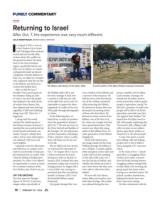
We met with Yair Moses,
whose father and mother were
both taken hostage. His mother
was released during the tem-
porary ceasefire, but his father,
Gadi, remains a hostage. He
shared how his father used to
travel around the world to guide
people in agriculture, saying “he
did it for a purpose, to make sure
people will be able to do better
agriculture and make sure they
can support their families.
” He
shared how his father loved to
talk with people, explaining that
“he loved to talk, willing to talk
with everyone on any subject.
Sports, agriculture, politics or
whatever it is. He loved people.
”
A man who spent so much
time talking with and helping
people; that is who is held in
Gaza, alongside 130+ innocent
others.
In the wake of Oct. 7, Israeli
agriculture is struggling. Many
workers from other countries
have left Israel, leaving farmers
struggling without enough help
in their fields. One morning my
group spent four hours volun-
teering on a strawberry farm. We
picked countless strawberries,
helping this family farm save
their crops from rotting.
We also volunteered with the
PURELY COMMENTARY
After Oct. 7, the experience was very much different.
LELA WEINTRAUB JEWISH@EDU WRITER
Yair Moses with photos of his father, Gadi. A small section of the Nova Festival massacre memorial.