

Looking Back
From the William Davidson Digital Archive of Jewish Detroit History
accessible at thejewishnews.com
62 | FEBRUARY 8 • 2024 J
N
The First Internet Craze
E
lizabeth King, the
JN’s digital manager,
said to me: “Did you
know that 2023 was the 30th
anniversary of Beanie Babies?
You should write about
them.” I had no idea what I
was getting into.
My initial thought was —
what do I know
about Beanie
Babies? Nothing.
However, they
did sound like
an intriguing
topic. I’ve never
owned one
of these little,
lovable, stuffed
plush toy animals, but like
most Americans, I was aware
of the pervasive “Beanies.”
To date, more than 800 types
of Beanie animals have been
produced. Little did I know,
however, that they have a
fascinating history.
Beanie Babies debuted in
1993, the invention of H. Ty
Warner. It also appears that
Warner, a bachelor without
children, relied heavily upon,
but did not fully credit, the
input of his close colleagues
(including contributions
of several women) in the
development of the toy.
The reclusive Warner is
not known as a great boss
and was later convicted of
tax evasion, but he has also
donated millions to charity.
“Beanies” were innovative.
First, they were deliberately
under-stuffed to make them
more huggable and pliable —
one can pose a Beanie unlike
most other stuffed toys before
them.
Perhaps the real
innovations are
related to marketing.
Beanies are often
considered to be the
first internet sensation,
debuting online in
1995. This, along
with a most brilliant
piece of marketing
— the inclusion of
“Teenie Beanies” with
McDonald’s “Happy
Meals” in 1996 — made
Beanies a national craze.
By 1997, Beanies were a
hot item for collectors, even
spawning counterfeit Beanies
… until the bubble burst
after a few years, as it does
for most fads. Still, a few
years ago, a rare “Brownie the
Bear” sold for $20,000 and
a limited-edition Princess
Diana Beanie sold for
$500,000 (I’d check your
closets now!).
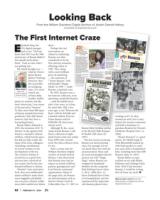
Although Ty Inc. never
made Jewish Beanies, I did
find a collection of eight
plush beanie-style toys online
from 1999 with a Jewish
twist: the Macca Beanies from
Oy Inc.
After a cruise into the
William Davidson Digital
Archive of Jewish Detroit
History, I also discovered
that Beanies have had an
impact on Jewish children,
parents, grandparents and
local Detroit communal
organizations. Many of
the pages that cite Beanies
are advertisements such as
that for Veena’s Cards &
Collectibles (Jan. 17, 1997) or
Beanie Baby birthday parties
at the Beverly Hills Racquet
& Health Club (June 20,
1997).
The best stories involving
Beanies are heartwarming
ones. For example, let me
cite Jared Moss’ bar mitzvah
announcement. Moss said
his most meaningful mitzvah
project was with “Magic
Hugs,” where Beanies are
wrapped in handmade
blankets for the nonprofit
Kids Kicking Cancer (June
2, 2011). Abby Bice, 12,
knew firsthand how it feels
to be hospitalized, and she
experienced the important
role Beanies played when
needing an IV. So, Bice
teamed up with Leo’s Coney
Island, her favorite restaurant,
and held a fundraiser to
purchase Beanies for Detroit’s
Children’s Hospital (Nov. 12,
2004).
“Beanie Bonanza” is a great
article. Dr. Phyllis Segal of
West Bloomfield teamed up
with third-graders to send
toys and cards to hospitalized
kids, including more than 600
Beanies (May 23, 1997).
Beanie Babies occupy
rarified toy air with Barbie,
Pokémon and Cabbage Patch
Kids. Wish I had invented
Beanies. I would be writing
this LB from my yacht.
Want to learn more? Go to the
DJN archives, available for free at
thejewishnews.com.
Mike Smith
Alene and
Graham Landau
Archivist Chair