

8 | JANUARY 25 • 2024 J
N
PURELY COMMENTARY
guest column
Putting Context in a Different Context
A
small confession:
I wrote some of
what you’re about to
read months ago, following a
magical week at the Shalom
Hartman Institute in Jerusalem.
I intended
to share the
enriching context
I’d gained with
the wider Detroit
community.
Then Oct. 7
happened.
We emerged
from Simchat Torah into
sadness and uncertainty
that words cannot measure.
One word in particular,
“context,” seemed particularly
insufficient. For some in the
anti-Israel camp, it became
a euphemism for justifying
or de-emphasizing murder,
kidnapping and sexual
assault. For those of us who
support Israel, context felt at
best superfluous, at worst a
distraction.
Yet as the war grimly passes
its 100th day, it’s becoming
clear that the complex
challenges facing Israel require
context, the real kind, more
than ever. So I find myself,
more than ever, wanting to
share what — and how — I
learned at the Shalom Hartman
Institute last summer.
Shalom Hartman, based in
Israel and North America, is
a think-tank and education
center focused on issues
of modern Jewish identity
and peoplehood. You may
be familiar with its English-
language podcasts, such
as Identity Crisis and For
Heaven’s Sake. In Israel, it runs
two high schools, a center for
shared society and a rabbinical
ordination program. On an
annual basis, it invites rabbis,
college students, gap year
students, Jewish educators and
lay leaders from all over North
America for intensive learning
seminars. Detroit attendees this
year included Rabbi Ariana
Silverman from the Isaac
Agree Downtown Synagogue
and Rabbi Aaron Starr of
Congregation Shaarey Zedek. I
participated in the Community
Leadership Program, geared
toward lay leaders, with
encouragement and support
from my synagogue, Adat
Shalom, and was joined by
Larry Winer of Oak Park and
Noah Tepperman of Windsor.
Israel was already beset by
internal tensions last June, yet
within Hartman’s campus we
calmly examined ideas. Have
you ever been on an airplane
as it ascends through stormy
weather? There’s a moment
where the buffeting suddenly
calms; flashes of lightning and
foreboding mist give way to
blue sky; and you can calmly
study the clouds below you.
This is how it felt to walk from
the intense heat of Jerusalem’s
streets, with its political
signage and noisy protests,
into Hartman’s majestic Beit
Midrash, high walls stacked
with Jewish books.
The theme of this year’s
Community Leadership
Program, Judaism in a
Liberal Age, was something
of a misnomer, at least to
those predisposed to think of
“liberal” as the contemporary
political camp. Here, the
term was framed as the basic
commitments of modern
Western civilization. The core
question of the week was
whether Judaism and liberalism
can, truly, coexist. Can liberals
embrace ancient Jewish notions
of obligation, sacrifice and
mystery? Can committed Jews
wholeheartedly embrace liberal
ideals of pluralism, individual
rights?
These aren’t hypothetical
questions. They were, in fact,
the essential ones being asked
last summer, when Israel
was teetering on a civil war
between liberal, largely secular
Israelis and its increasingly
illiberal, largely religious
government. It was no less
relevant to an American Jew
like myself, loyal both to the
ideals of the pluralistic society
in which I live and the tug of
my ancient people.
The question has become
more urgent now, as Israel
fights for its existence against
the worst elements of the
Middle East while also trying
to preserve its commitment to
Western and Jewish values, and
American Jews find ourselves
increasingly isolated (and at
times conflicted) in supporting
this fight.
We examined these
questions as Jews have for
millennia — rigorously and
with an openness to multiple
conclusions. Torah must mean
more than “... a beautiful line,
an instructive spiritual or
moral idea” but also “ideas
that might sound ... archaic,
oppressive ... that we have a
hard time believing anymore.”
I found myself, in one
session, connecting deeply
David Zenlea
Special to the
Jewish News
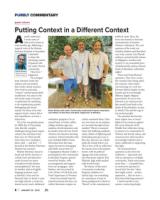
David Zenlea with other Community Leadership Program attendees
Larry Winer of Oak Park and Noah Tepperman of Windsor.