

8 | JANUARY 18 • 2024
J
N
essay
Making good on a 50-year
promise to Israel
M
y now-husband
Tim and I were
in college 50
years ago when the Yom
Kippur war broke out. We
didn’t know
one another
then, but we
both called
home asking
our parents if
we could go
to Israel and
support the
war effort. Unfortunately,
we couldn’t. However, five
decades later, the minute
Jewish National Fund-
USA offered us a chance to
volunteer, we signed up for
the first mission.
We had already been
planning to go to Israel
on Oct. 16 with the
organization’s Arava Task
Force, an initiative I’ve
been involved with since
its inception in 2010. I
also participated in the
dedication of the only
fortified indoor playground
in Sderot, which also serves
as a bomb shelter (how about
that for an oxymoron?) in
2008, the same playground
that suffered a direct hit on
Oct. 7.
So, a little more than two
weeks ago, Tim and I found
ourselves heading out to
a farming community in
Israel’s south located close to
the border with Egypt and
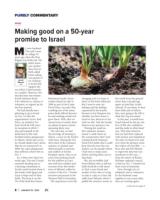
Gaza to help tend to their
fields. The farm is on the
3% of the land that former
Palestinian leader Yasser
Arafat refused to take in
2000 as part of the Camp
David Peace Accords, thus
scuttling one of the many
peace deals offered because
he said nothing would ever
grow there. Well, after we
cleared tons of weeds, there
are plenty of green onions
sprouting there now.
The next day, we had
the privilege of farming in
Sderot, a town on the border
with Gaza. During the five
short days of the volunteer
mission, we packed and
delivered gifts to patients
and soldiers at Seroka
Hospital, spent a day on an
army base packing snacks
for the soldiers in Gaza,
met with lone soldiers and
evacuees from the border
town of Shlomit, talked to
victims of the Oct. 7 border
invasion and prayed at the
Western Wall in Jerusalem.
The experiences were life-
changing and too many to
share in this brief reflection.
But I want to note my
feelings and the feelings
expressed by the Israelis
because every Diaspora Jew,
whether you have been to
Israel or not, deserves to do
what we did. And the Israelis
deserve your presence, too.
Visiting the south on
this volunteer mission
meant I could check on
the communities that I had
watched Jewish National
Fund-USA build, that I could
hear directly from the city
leaders, see the people whom
I had met so many years
before and hug them, just to
hug them.
Osi, the incredible chef
from Ofakim who is still too
shell-shocked to talk about
it; Yael, a new friend and
mother of five who is trying
to take it a day at a time; the
rabbi from Shlomit, where I
pulled the sweetest carrots in
the world from the ground
more than a decade ago,
again on land that Arafat
refused. To see them, to hear
their faith and to believe
they were going to be OK is
what this trip was about.
In the past, I would leave
Israel buoyed by the joy, the
love of life, the confidence
and the pride in what Israel
was. This time, however,
that joy had been replaced
with anxiety and trepidation.
Yet what we heard over and
over from the farmers, from
the widow of Uriel Bibi — a
hero who had left Shlomit
to report for duty but was
murdered on the way —
from the mayor of Ramat
HaNegev regional council,
is that on Oct. 7, Israelis lost
their trust in humanity.
Now, through acts of
solidarity and as volunteers
by the busloads come
together to save each other,
they are trusting again,
PURELY COMMENTARY
continued on page 11
Lauren
Mescon
JNS