

8 | JANUARY 4 • 2024
J
N
violence that took place within
Israel’s mixed Jewish-Arab cities
in May 2021. Understanding
the reason for this support for
coexistence and inclusiveness
during such a devastating war is
therefore significant.
One factor that may be bring-
ing together Israel’s Jewish and
Arab citizens is their shared
sense of grief. Approximately
50 to 100 of the 1,200 Israelis
who were killed, and some of
the people who were kidnapped
during Hamas’ rampage on Oct.
7, were Arab citizens of Israel.
Indeed, Hamas fighters
made no distinction between
Jew and Arab during their
onslaught, and many of those
bloody instances — and sto-
ries of heroism where some
Israeli Arabs, such as Awad
Darawshe and Amer Abu
Sabila, literally sacrificed them-
selves to save their Jewish coun-
terparts — spread throughout
Israel via social media.
As Israeli-Arab activist
Muhammad Zoabi wrote just
a few weeks after Hamas’
attack, “On Oct. 7, it was that
same exposure that made us
feel more Israeli than ever —
when we saw … the footage
of our mass murder … it trig-
gered a deep sense of solidar-
ity from the Arab community,
bolstering a shared sense of
being Israeli.”
A second factor may be the
robust cooperation between
Israel’s Jewish and Arab citi-
zens at the civil society level
during the war. Many of the
civil society organizations that
have been assisting the Israeli
families that were hurt by the
Oct. 7 attack have focused
specifically on coexistence
and cooperation between Jews
and Arabs in Israel. Perhaps
the most prominent example
of such cooperation is the
Jewish-Arab relief center in
Rahat, Israel.
A couple of weeks ago,
I attended an event at
Hebrew College in Newton,
Massachusetts, where we met
Shir Nosatzki and Hanan
Alsanah, two of the founders
of the relief center, and they
spoke about the work they do.
According to Shir and
Hanan, the Jewish-Arab relief
center in Rahat is the first of
its kind, and they are hoping
to create four more centers in
northern Israel. Its primary
purpose is to provide services
for the basic needs of families
who were hurt by the attack on
Oct. 7 and to create a space for
Israeli Jews and Arabs to see
the humanity in one another.
About 1,000 volunteers provide
services for approximately
500 families, which is roughly
evenly split between Jewish and
Arab families.
Shir further elaborated on
the ways their services and
this space for coexistence are
helping to build a more inclu-
sive Israeli identity:
“Our work helps push this
new identity into a place of
partnership with fellow citi-
zens who wish to work toward
a shared future and who value
life and safety. We help rede-
fine who’s our partner in this
aspiration for life and who’s an
agent of chaos and fear. This is
the real division. We’re draw-
ing a new line — this is not a
war between Jews and Arabs,
it’s a war between extremists
and moderates, a war between
agents of fear and those who
seek life.”
Shir’s comments indicate an
opportunity in Israel that must
be salvaged. The events on
Oct. 7 will inevitably reshape
Israeli identity for the foresee-
able future, but what that new
Israeli identity will look like
may depend on what happens
now. Will it be a more exclu-
sionary identity where extrem-
ists on both sides continue to
create division and conflict, or
will it be a more inclusive civic
identity where Jews and Arabs
work together to ensure a
future with peace and equality
between them? We must work
together to make sure it is the
latter.
Jonah Naghi is a Boston-based writer
and the chair of Israel Policy Forum’s
IPF Atid Steering Committee in the city
of Boston.
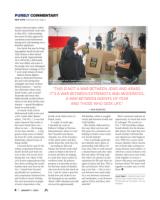
“THIS IS NOT A WAR BETWEEN JEWS AND ARABS,
IT’S A WAR BETWEEN EXTREMISTS AND MODERATES,
A WAR BETWEEN AGENTS OF FEAR
AND THOSE WHO SEEK LIFE.”
— SHIR NOSATZKI
PURELY COMMENTARY
NEW HOPE continued from page 4
An Arab woman and a Jewish woman put together
supplies at the Jewish-Arab relief center in Rahat, Israel
SHIR NOSATZKI, 2023