

OUR COMMUNITY
continued from page 11
ON THE COVER
12 | JANUARY 4 • 2024 J
N
The Shinshinim participate in community
events almost nonstop, from various holiday
events for Chanukah and Sukkot, speaking
events with audiences ranging from students to
Holocaust survivors, personal projects they’re
working on and more. They work to present
Israel in as many places as possible with as
many perspectives and personal experiences as
possible.
A DAY OF SHOCK AND HOMESICKNESS
The 2023-24 Detroit Shinshinim arrived in
late August and, by early October, they had
settled into their roles. What had been a typical
gap year for Shinshinim before them quickly
changed on that fateful Saturday in October.
When news of the Hamas-led attack on Israel
started trickling out, and their families began
reaching out to them, they were confused and
shocked. As time went by, and the scale and
immediate implications of what happened were
fully understood, a feeling of wanting to return
home came over many of the Shinshinim.
For Erela, one of the first feelings she had was
guilt, wanting to return home to grieve with
family and friends. She couldn’t
turn away from watching the news
and checking social media.
Itamar’s mother called him that
morning informing him of what
happened, assuring him their fam-
ily was OK and delivering news
that his older brother was called
into the IDF. Itamar also wondered
what he was doing in Detroit and
not in Israel, wanting to find a way
into the army. The 18-year-old
said it was the most terrible time
he’s had in his life, seeing “horror
movie stuff” on the news.
“I’
d never felt that feeling before,
like your house is burning and all
of your family is inside, but you are watching,
”
he said.
Ofri initially didn’t know how to feel.
“I didn’t know whether I wanted to be here
or go home,
” she said. “Like, where am I the
most efficient? Where am I going to
impact the most?”
Shahaf, who had a very different
18th birthday than expected, says
those first few days after the attack
were hard because they were still
trying to figure out how they felt
and if their family and friends were
OK.
Shahaf and Erela are from Ahuzat Barack, a
small moshav (settlement) in the Jezreel Valley
consisting of about 700 families. Because it’s
small, everybody knows everybody. From that
moshav, around 10 people went to the desert
music festival near the Gaza-Israel border. Only
three of them came back.
“We had two siblings of a good friend of ours
who were murdered that day. We’ve known him
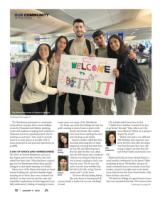
The Shinshinim arrive in Detroit in August.
Erela
Sabag
Itamar
Grife
continued on page 14
Ofri
Lellouche