

DECEMBER 14 • 2023 | 31
around the country. Often the
number of volunteers exceeds
the number of work stations.
David notes that outside
the cafe were “people waiting
until someone comes out to
leave, and then they can come
in. At times the line is so long
that we just turned around
and went home.”
MAKING BEEF JERKY
But on another occasion,
David went elsewhere to
join Beef Up Our Boys (see
story on page 32), “a group of
people who are making beef
jerky for soldiers out in the
field. They were looking for
donations and volunteers,
too.”
Soldiers at a base can get
food delivered or made there,
but soldiers out in the field
need some food they can
carry, that doesn’t spoil, and
that can give them a boost.
The Israeli military calls this
Manat Krav, “Combat Food,”
the equivalent of what the
USA military calls MRE,
“Meal: Ready to Eat.”
David describes the steps
in that process: “They take a
brisket, slice it up, and ... cut
out most of the fat. Then they
marinate it in vats.”
From there, they move the
meat into trays, which go
into the dehydrators. When
it is sufficiently dry, the meat
gets cut into bite-sized pieces,
which each get weighed and
put into packages for vacuum
sealing. That process should
leave the meat ready to keep
at room temperature for
extended time.
David and Mira have
returned to Beef Up Our Boys
at different locations in Beit
Shemesh, as the project has
grown to meet the growing
demand for Manat Krav.
HELPING ON THE FARM
Even with their heavy
schedule of volunteering,
Mira and David find time to
take part in an Ulpan, a class
in conversational Hebrew.
One of the fellow students
invited them to help at a
lettuce farm just outside of
Beit Shemesh. Mira describes
the scene:
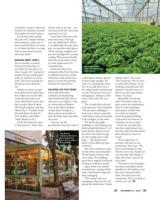
“You can see the
greenhouses from the road. It
is hydroponic lettuce, grown
in these huge troughs. We
went as a small group, about
five of us, and there were a
few other people volunteering
as well. The person who was
managing us, telling us what
to do, what tasks; she was
great.
“We actually did each part
of the process,” she continued.
“We put these seedlings in
foam trays, about a meter by
a half meter, and we laid them
in the troughs, in the water.
“We had to put eight
seedlings in each floating tray.
Each trough held about 11 of
these floaters that fit across
the short end of the trough.
So, the troughs were really
huge … they had at least
three or four different types
of lettuce.”
After that, volunteers went
on the other end, and pulled
off the heads of lettuce that
were ready. The seedlings
grow into a regular-sized head
of lettuce in about a month.
Again, there was another
assembly line: cutting off the
roots, checking for bugs and
then packaging.
“The woman who was
managing us kept on her cell
phone the whole time, I think
taking orders,” Mira said.
“She would say, ‘Oh, we have
to make 200 of these.’ So we
would go and pick them off
whatever tray she sent us to.
She let us take some lettuce
home, of course.”
Meanwhile, David and
Mira will need to take up
their search for employment.
Mira is a microbiologist
and expects to find work
in a clinic or hospital.
David anticipates finding
a placement in business, in
customer service or sales.
Given the stressful time
that they made aliyah, how
do Mira and David feel about
their decision to move to
Israel?
“We are glad that we
are here, and that we can
contribute,” Mira says. “We
have a real feeling of unity,
which is very nice. People are
very friendly and willing to
help. They have concern for
each other.
“We know a lot of families
that have immediate family
members in the military, and
they are concerned about
them. We don’t have that
connection. We try to help as
much as we can.”
The lettuce farm
where the Benjamins
volunteered
The Aroma
Espresso Bar turns
out sandwiches
each day to feed
the soldiers.