

NOVEMBER 30 • 2023 | 71
were separated when she
was sent to Bergen-Belsen
and he to Dachau, but
after the war Morris found
her in a displaced persons
camp. They married and
immigrated to Canada along
with surviving members of
their extended families.
Lee also shares an
emotional remembrance
about him, his brother
and sister accompanying
their mother to the 50th
anniversary commemoration
of Bergen-Belsen in 1995.
“My parents and those
relatives aren’t here
anymore,” notes Lee,
whose familiar first name
came from his mother’s
mispronunciation of Gary.
“I grew up hearing about
the horrors of World War II,
you know? I’m here because
they survived. I have a
responsibility to tell their
story.”
There’s further trauma
as Lee’s father passed
away when he was 12, a
loss he acknowledges was
“emotionally unattended”
over the years, until he
began writing the book.
There are happy memories
as well, of family gatherings
and traditions and growing
up in a Jewish neighborhood
(Willowdale) in Toronto,
and Lee drops enough
Yiddish throughout the book
to make his entire family
tree proud.
Assisted by Daniel Richler,
son of the late Canadian
novelist Mordechai Richler,
Lee made sure those remain-
ed in the book even after the
1,200-page first draft was
being edited.
“I don’t think the
description of Yiddish food
was in the first cut,” he
explains. “I thought it
was important to bring
some of that personality
back in.”
Lee does chronicle
antisemitic encounters
as a youth, particularly
in school at the hand
of “jerks trolling the
streets and hallways for
Jews to torment.”
And when he tried
to quit attending
Hebrew school before
his bar mitzvah,
Lee was supported
by a man in the
neighborhood
who helped usher
him through
the process. (A
photo of his bar
mitzvah painting
is included in My
Effin’ Life).
RENAISSANCE
MAN
Lee, of course,
went on to rock
‘n’ roll stardom with Rush,
receiving an Officer of the
Order of Canada honor
in 1996. He’s been cited
as a key influence by the
generations of bass players
that followed, contributed
a guest vocal on the 1981
hit “Take Off” by the
comedic McKenzie Brothers
(including early classmate
Rick Moranis) and released
a solo album, “My Favourite
Headache,” in 2000.
Lee also became a noted
baseball enthusiast and
memorabilia collector,
occasionally providing
commentary for game
broadcasts. He also is an
avid wine connoisseur and
birdwatcher.
His bass guitar
collection led to
Geddy Lee’s Big
Beautiful Book of
Bass, and, on Dec.
5, he’ll premiere
Geddy Lee Asks:
Are Bass Players Human Too?,
a four-part docuseries on
Paramount+.
Rush last toured during
2015 and came to an end
in 2018. Drummer Neil
Peart’s death in January
2020 as well as his mother’s
worsening dementia put Lee
in “a funk” that encouraged
him to write the memoir. It
also rekindled Lee’s interest
in making more music; he
recently released a pair of
demos from “My Favourite
Headache” and plans to do
more recording with Rush
guitarist Alex Lifeson.
“There were some
cathartic things about
writing this book that, in a
way, clarified my thinking
and helped me step out of
that fog,” says Lee, whose
wife, Nancy, converted to
Judaism when they married
in 1976. His grandson
Finnian refers to him as
Zaidy. “I’m excited to be
onto the next stage of my
life after this.”
DETAILS
Geddy Lee talks about
My Effin’ Life at 8 p.m.
Monday, Dec. 4, at the
Fillmore Detroit, 2115
Woodward Ave. Doors
at 7 p.m. (313) 961-5451
or thefillmoredetroit.com.
was in the first cut,” he
was important to bring
some of that personality
antisemitic encounters
as a youth, particularly
streets and hallways for
DETAILS
His bass guitar
collection led to
Beautiful Book of
, and, on Dec.
5, he’ll premiere
Are Bass Players Human Too?
Headache” and plans to do
more recording with Rush
at 7 p.m. (313) 961-5451
or thefillmoredetroit.com.
PHOTOS COURTESY GEDDY LEE ARCHIVE/HARPER BOOKS
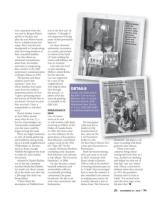
Young Geddy
with his
mother and
brother Allan
display early
Canadian
Beatles LPs
Twist and
Shout and
Beatlemania.
Young Geddy Lee with his
father and sister Manya