

64 | NOVEMBER 30 • 2023
J
N
HEALTH
I
t’s no secret that today’s
youth have navigated a diffi-
cult past few years. Between
the COVID-19 pandemic, social
isolation and learning remotely,
to the Ukraine-Russia war and
now the ongoing Israel-Hamas
crisis, times have been turbulent
for our youngest generations.
Pair that with the everyday
challenges of being a child or
teen — the pressure and compe-
tition of social media, family life
or simply navigating school —
and mental health experts say
this recipe contributes to the rise
of mental health crises among
youth.
In October 2021, a national
emergency in child mental
health was declared. Suicide
rates among young people ages
10 to 24 skyrocketed by 62%
between 2007 and 2021, and
mental health disorders such as
depression and anxiety contin-
ued to climb.
Now that two years have
passed since the emergency was
first declared, the situation has
only gotten worse for youth,
especially given the current geo-
political climate.
Jewish-owned Birmingham
Maple Clinic, which has been
in business for 50 years this fall,
is no stranger to the many diffi-
culties today’s youth are facing.
The Michigan mental health
clinic, which has expertise in
more than 50 specialties, includ-
ing ADHD and general anxiety
disorder, provides treatment for
local youth and/or their families.
BREAKING DOWN WALLS
The needs vary greatly. Some
kids, like the preteen son of a
Jewish community member
who wishes to remain anony-
mous, struggle with the after-
math of his parents’ divorce. In
this case, the child began ther-
apy following the divorce, but
was also having a tough time
with the effects of the COVID-
19 pandemic and the social iso-
lation that followed.
For this child in particular,
therapy at Birmingham Maple
Clinic became a neutral out-
let where he could share and
understand his feelings with a
third-party person who held
no stakes in the divorce. Siding
with neither mom nor dad, the
preteen was able to find reas-
surance and, most importantly,
realize it was normal to feel the
way he did.
While the child was reluctant
to try therapy at first, he’s bene-
fited immensely from the care,
and has even begun comforting
other friends also going through
divorce within their family. “For
the first three months of the
divorce, I felt my son was fine,
”
explains his father. “But then I
started noticing behaviors where
he became very isolated.
”
The typically outgoing pre-
teen had become quiet and
holding what his father calls
“superficial conversations”
where he didn’t want to explore
what he was feeling.
Yet once he started talking
with a therapist, those walls
disappeared — and the healing
process began. “He started get-
ting stuff out; he started sharing
more,
” his father recalls.
THE DARK SIDE OF
SOCIAL MEDIA
The example above is just one of
many mental health care needs
kids deal with today.
“I would love to say that
everything is getting better, but
we live in a really complicated
time right now,
” explains Dr.
Brooke Weingarden, who has
worked at Birmingham Maple
Clinic for 10 years and spe-
cializes in adolescent and child
psychiatry.
While social media comes
with numerous benefits — a
connected world and having
information available at the
touch of your fingertips — it
plays a dark role in mental
health across all age groups, but
even more so for our youngest
generations who are extra sus-
ceptible to potentially triggering
content and, of course, simply
fitting in with others.
Weingarden explains that
previous generations weren’t so
readily exposed to world prob-
Between a global pandemic and ongoing wars, kids
face increased mental health challenges.
Youth Mental Health
Crises Are on the Rise
ASHLEY ZLATOPOLSKY CONTRIBUTING WRITER
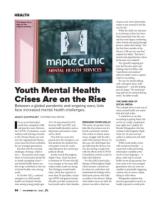
The Maple Clinic
logo on the
original building