

44 | NOVEMBER 23 • 2023
J
N
A
s I write this, I’m
looking at my hand,
where scattered flecks
of cobalt blue trace the outline
of a Magen David. While this
could be an ad for waterproof
blue eyeliner — the pigment
clinging on for dear life four
days later — I find myself now
wishing to retrace the lines
when I get home.
After all, for centuries, Jews
have been forced to identify
themselves. From Nazi yel-
low stars to donkey-shaped
patches in 600s CE Baghdad,
clothing bells in 1000 CE Egypt
to Judenhut (or “Jew’s Hat”) in
Medieval Europe, these markers
have served to separate, “oth-
erize” and physically mark as
inferior — as different.
Until college, I’
d never phys-
ically projected as Jewish. I
have blue eyes and a French-
Catholic last name. I think
I subconsciously wanted to
distance myself from any of the
distinguishing features used
for centuries to demean and
humiliate Jews. I remember my
visceral reaction when I went
to Universal Studios in middle
school, the disgust I felt when
seeing the animated Gringotts
goblins whose grubby hands
clung onto coins with faces
straight out of the Protocols of
the Elders of Zion. These stereo-
types extend from the hook-
nosed Watto (who happens to
have a thick Yiddish accent)
in Star Wars’ The Phantom
Menace to Shakespeare’s Shylock
and Charles Dickens’ Scrooge.
In the face of these outward
projections and stereotypes —
of this iniquitous caricature
ingrained in popular culture
— we must ask ourselves what
we can do. Thousands of years
of history have taught us that
we will never and can never
make everyone accept us.
Yet, there’s been thousands of
years of persecution, and guess
who’s still here.
The solution, therefore, is not
to cower from our Jewishness
— from what identifies us as
part of this amazing communi-
ty. The lessons from centuries of
forced separation have been to
cultivate a unique identity and
recognize our traits that make
us special.
These traits are determina-
tion, love and community. It’s a
passion for bettering the world
and lifelong learning, and then
imparting that same joy onto
the next generation. It’s why
the story of coming to America
with nothing and making sure
your children have a better life
is so common.
It’s not about wallowing in
adversity — it’s about taking the
lessons learned and then focus-
ing on what we can do to make
our present and our future bet-
ter rather than dwelling on
the past. This is how we will
overcome the current challenge,
and it starts with embracing our
identity, with leaning in. It starts
with being proud.
I first realized this my fresh-
man year of college, when
antisemitism on campus com-
pelled me to go to Israel with
Birthright.
As I wrote then: “While I felt
tempted to think that as just
one person, I couldn’t do any-
thing to help, I decided it was
my responsibility to educate
myself on the current conflict,
which would enable me to then
educate others and address the
tough questions with newfound
insight … My goal was to see
what was happening in Israel
firsthand so I could come back
and be an advocate.
”
Three years on, and I wish I
could say that the situation on
campus was better, not worse.
But, I’ve spent the past three
years ringing the alarm bell,
posting on social media when
flyers are passed around saying
that Jews are responsible for
COVID, or the rock (a local
campus art site) is vandalized
on Yom Kippur, or protesters
line the halls of the business
school to block intro sessions
for Israeli summer programs
like Birthright Excel.
The climate on campuses
has been building for years
and years, and that knowledge
doesn’t make seeing people
Show Your Jewishness
Isabel Allard } jewish@edu writer
for college students
by college students
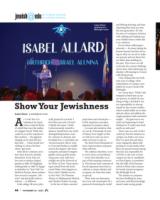
Isabel Allard
speaking at a
Birthright event.