

50 | OCTOBER 12 • 2023 J
N
D
uring the 1970s, Jewish baby boomers were urged to
get a new genetic screening test for Tay-Sachs, a fatal
disease that is more common among Ashkenazi Jews.
The test analyzed blood enzymes to look for the recessive
gene that may cause Tay-Sachs when both parents
carry it. There is no treatment for Tay-Sachs and
children usually die at a very early age.
Melanie Hardy, who has master’s degrees in
biology and genetic counseling, is director of
genetic counseling for JScreen, a national non-
profit organization that is a public health initiative
of Emory University’s School of Medicine. She
says that community-based carrier screenings
have resulted in a 90% decline in Tay-Sachs.
“
A lot of rabbis do great education for the testing, and there
have been a lot of screenings on college campuses,” Hardy
adds.
However, there are still a small number of Jewish individu-
als who carry the Tay-Sachs gene and may pass it on to their
children. The disease is also more prevalent among Amish
and French-Canadian Cajuns than in the general population.
WOMEN’S HEALTH
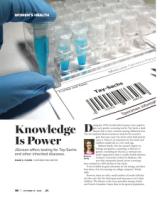
JScreen offers testing for Tay-Sachs
and other inherited diseases.
Knowledge
Is Power
SHARI S. COHEN CONTRIBUTING WRITER
Melanie
Hardy