

26 | OCTOBER 12 • 2023 J
N
the UK. We have a generous allocation of
holidays here; I personally get around 25
days by default. Plus, being located centrally
allows me to travel to fabulous places like
Spain or Italy within a few hours. It’s much
more convenient compared to the U.S.,
”
Feczko observes.
Feczko notes that this emphasis on work
in the U.S. also influences social interac-
tions, with most interactions feeling like an
interrogation about one’s profession. “Here
in the UK, the approach is more relaxed,
with casual starters such as comments on
the weather. It fosters a slower, more natural
development of relationships.
”
He remains undecided about the possi-
bility of returning to the U.S. in the future.
Being content in the UK and holding
German citizenship, which grants him
the freedom to reside in any EU country,
broadens his residential options. While
acknowledging the hardship of being sepa-
rated from friends and family, he has found
considerable advantages in living abroad.
“My time overseas has revealed how
American-centric my understanding used
to be, to the point that I failed to fully
appreciate the rich diversity of people and
cultures,
” he shares. “Residing in London
has allowed me to recognize the privileges I
had back home while also valuing the work-
life balance and multicultural environment
that the city offers, particularly given its
historic role as a focal point in the English-
speaking world.
”
DOWN UNDER
Another favored destination for Americans
is Australia. Phillip Yip, a seasoned immi-
gration attorney based in Sydney, notes the
complexities of the nation’s immigration
framework.
“Our immigration system is managed
by the Department of Home Affairs, and
we usually have about 190,000 migrants
each year. Roughly 70% of these are skilled
workers, and the other 30% come for family
reasons,
” he says.
Yip adds that Australia is ideally looking
for immigrants younger than 45, with good
education, strong English and at least two
years of relevant work experience after their
education.
Ian Rathmell, 34, was born to a
multi-generational Southern Jewish family
in Birmingham, Alabama. “Growing up, I
never really envisioned living outside of the
U.S. In the South, international perspectives
weren’t readily accessible,
” he recalls.
Despite feeling grounded in the region,
the allure of experiencing more of the world
led him to seek opportunities abroad. While
working in finance in Austin, Texas, he
pushed for a transfer to a global office. In
2016, his request was granted, offering him
a chance to move to the company’s Sydney,
Australia, branch.
“There was a deeper desire to explore and
see more, driven partially by Sydney’s pro-
gressive landscape. Being a gay Jew, I was
also drawn to the open-minded approach to
the LGBT community in Sydney,
” Rathmell
shares, highlighting the importance of
inclusivity in his decision to relocate.
In Australia, Rathmell finds a political cli-
mate more in tune with his personal values,
appreciating the universal healthcare system
and a heightened sense of safety compared
to the U.S. “The safety here is notable. Yes,
we have guns, but they are regulated appro-
priately, avoiding the extreme scenarios
witnessed in the U.S.,
” he observes.
Furthermore, Rathmell praises the
Australian lifestyle that aligns well with his
preferences, “In America, it’s hard to find
a city that ticks all my boxes — being near
a beach and the mountains, having public
transportation, walkable and great weather.
Sydney checks so many boxes, and Australia
just has so much outdoor adventure and so
much to explore and see,
” he adds.
As more Americans entertain the idea
of relocating, their choices are motivated
by a complex interplay of factors including
work-life balance, safety and a desire for
broader cultural experiences. For American
Jewish millennials like Rathmell and
Feczko, it is evident that the move abroad
has ushered in a period of self-discovery,
offering a refreshing deviation from the
expectations set in the U.S. They have found
countries that align more closely with their
individual values, where the approach to
work, politics, and even casual interactions
offers a breath of fresh air.
Moving abroad is a significant step, filled
with complexities such as ever-changing
immigration laws and the inherent chal-
lenges of building a life in a new country.
Many Americans contemplating this path
might feel overwhelmed by the hurdles that
lie ahead and ultimately decide not to follow
through with an international move. Yet, for
a considerable number, the prospect of a life
more aligned with their personal values and
aspirations, coupled with enhanced safety,
might very well outweigh the challenges.
Dan Brotman is the executive director of the Windsor
Jewish Federation and oversees its J Welcome Home
immigration program. In addition to this role, he is the
founder of Rootless Mobility, a consultancy that guides
clients who are unsure about their emigration options.
continued from page 24
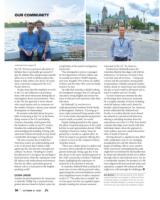
Author Dan Brotman
in front of Canada’s
Parliament in Ottawa
Ian Rathmell with his
Australian partner,
Brando, in front of the
Sydney Opera House
OUR COMMUNITY