

OCTOBER 5 • 2023 | 49
J
N
Brenda said. “David, Paul and
I worked hand-in-hand on
many of the aspects of the pro-
duction.”
As the friendship developed
between the Spellman family
and the Hofferts, they surpris-
ingly discovered that members
of the two families worked
together in silent movie
theaters in Poland. While
Spellman was at the piano,
Paul’s father, from a heritage of
cantors, was singing.
“The film is a metaphor
for what keeps going on
around the world,” Paul said.
“Whenever things start get-
ting tough, many leaders will
just start using a group as a
scapegoat and rile up public
sentiment against that group.
I know that audiences will feel
very drawn to the facts of the
film.”
In the film, facts include
enactment of international
honors given to point out how
Spellman was allotted a place
to hide and what was achieved
by Spellman.
PROGRAM HIGHLIGHTS
Paul Hoffert, who will be with
his wife to talk about the film
and the person being featured
in that film, feels a close con-
nection to Michigan. Besides
performing in cities with his
band, Lighthouse, he would
visit Ann Arbor to see his
brother in university atten-
dance there.
The senior Hoffert is seen
in the movie conducting parts
of Spellman’s “Rhapsody 1939-
45.” Performing that entire
piece in the two Michigan
theaters will be members of
the Michigan State University
(MSU) Symphony conducted
by Octavio Más-Arocas, asso-
ciate professor of music and
MSU director of orchestras.
With the finding of the diary
and some reworking of film
content, it took 12 years to
make the production.
Amy Simon, who teaches
about the Holocaust at MSU
and has just written the book
Emotions in Yiddish Ghetto
Diaries, will cover the his-
torical context of Spellman’s
life. Her presentation is one
of many university collabora-
tions she has had with Michael
Serling of the Michael and
Elaine Serling Institute for
Jewish Studies and Modern
Israel.
“I thought the film was
very touching about the role
of music in Leo Spellman’s
survival and life in general,”
Simon said. “That music kept
him able to find meaning and
beauty. I find these individual
stories very powerful in terms
of human resilience and the
ability to find something good
in the very worst.”
Simon’s portion of the pro-
gram and the Hofferts’ expe-
riences with Spellman and
the film can be heard at 7:30
p.m. Saturday. Simon can be
heard at 2:15 p.m. on Sunday
as part of the program that
concludes with the Hofferts
being interviewed by Rabbi
Eli Mayerfeld, CEO of the
Zekelman Holocaust Center in
Farmington Hills.
“There are hundreds of dia-
ries that have survived,” Simon
said. “I’m excited to give a clos-
er look into that and what it
meant for people to be record-
ing their experiences. Finding
something, in Leo Spellman’s
case music, to hold on to gives
us a sense of the resilience of
humanity.”
Details
“The Lost Rhapsody: A World War II Survival Story
and Musical Legacy” first will be presented at 8
p.m. Saturday, Oct. 14, at Michigan State University’s
Fairchild Theatre, 542 Auditorium Road, East Lansing.
Introductory remarks 7:30 p.m. $10-$13.50. Free for stu-
dents and those under 18. (517) 355-5340. music.msu.
edu/events.
The second performance is at 3 p.m. Sunday, Oct. 15,
at the Berman Center for Performing Arts in the West
Bloomfield Jewish Community Center. Introductory
remarks 2:15 p.m. $18. (248) 406-6677. https://jdetroit.
regfox.com/the-lost-rhapsody-a-musical-legacy.
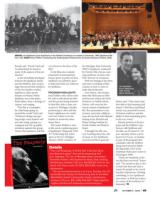
LOST RHAPSODY PRODUCTIONS
Leo Spellman
(Leon Szpilman)
with fiancée
Mania Goldman.
ABOVE: Leo Spellman (Leon Szpilman) in the Ghetto Orchestra he created in Ostrowiec, 1941 (Spellman 6th
from left). RIGHT: Paul Hoffert conducting the Podkarpacka Philharmonic Orchestra Rzeszow Poland, 2016.