

10 | SEPTEMBER 21 • 2023
column
On the Ground in Morocco:
Sharing Hope, Paving the Way
I
was asked to join a jump
team of first responders
heading to Morocco
to provide initial medical
treatment and assess how the
organization I
volunteer for,
United Hatzalah,
could best assist
survivors of the
earthquake that
killed more than
2,800 people —
and counting.
As a paramedic and
volunteer first responder
who is always on call, I’m
used to dropping everything
— but this emergency was
a lot bigger than the ones
I’m usually called to, which
at most involve a handful
of patients. The situation
in Morocco involves a large
segment of the country’s
population. How could I not
help? I immediately packed a
bag.
As the town where I live,
Kanaf, is in the far north of
Israel, I only had about 30
minutes from the time I got
the call to leave for the airport;
the jump team was to depart
that night.
Everything was moving very
quickly, there was no time to
absorb information or prepare
for what was ahead. We had
very little information to go
on until we hit the ground in
Morocco. Leaving my family
behind, and calling out of
work for a week, was a bit
surreal, but I knew people
needed help, so that’s what I
did.
We arrived in Marrakesh
after a stopover in Europe.
The jump team’s goal was to
meet with community leaders
and government officials
and map out where help was
most needed. This was done
in order to pave the way for a
much larger team, should one
be needed.
From what we have seen so
far, the need here is great, and
everyone we meet is thankful
that we came to help. In spite
of the stress and tragedy of the
situation, I’m happy to be here
to pave the way for a larger
team, to enable them to reach
more people, more efficiently.
As we travel through the
mountain villages to the
southwest of Marrakesh,
areas local teams haven’t
been able to reach yet, we
are gaining a much greater
understanding of what’s
needed here. We focused
on these areas specifically
because other agencies haven’t
been here yet, and there
are no local hospitals in the
region. We’ve gained a much
greater understanding of their
immediate basic needs and
are trying to provide as best
we can, while connecting the
individuals we help with local
resources.
The overall impression I
am left with, based on my
interactions with all those I’ve
met with and helped thus far,
is one of simple shock. The
people here lost everything,
including their homes, in a
matter of seconds.
We learned of one such
family from a representative of
the local Jewish community in
Marrakesh. The family, whose
home was in the old city,
had been left with nothing.
Some family members were
in shock, while others were
strong and resilient; the head
of the household had still
opened his store, despite
losing his house.
We worked with the
family to help them process
the situation and made
sure to connect them with
local resources — but those
resources are spread thin.
Outside help is needed, and
we relayed that back to our
teams in Israel.
I hope that in the coming
days, we are able to reach
many others and that our
second and much larger team
will arrive soon to continue
and widen the scope of the
work we have begun. I am
proud to be here to share hope
with the survivors and pave
the way for additional aid for
them.
Erez Gollan is a volunteer paramedic
from Kanaf in Israel’s Golan Heights.
He works as a clinical medical
researcher and is married with two chil-
dren. He was born in Israel but spent
his teenage years in South Africa.
PURELY COMMENTARY
Erez Gollan
JNS.org
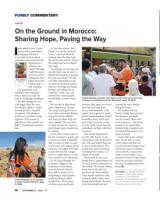
United Hatzalah volunteer Erez Gollan works with local community
members in earthquake-stricken Marrakesh, Sept. 10, 2023.
United Hatzalah on the ground
in quake-stricken Morocco, Sept.
11, 2023