

8 | SEPTEMBER 7 • 2023
column
Everything My College Student Needs
to Know He Learned at Synagogue
L
ast week we did it: My wife
and I dropped our eldest
son off for his first year of
college. As you can imagine, it
is a heady, emotional moment.
There is pride
and joy mixed
with anxiety and
the bittersweet
sense that this
primary chapter
of parenting is
coming to a close.
As parents,
we’ve asked each other so many
questions in the weeks leading
up to the big day. Will he eat?
Will he meet new people? Will he
take advantage of all the school
has to offer? What will his Jewish
experience be like? What about
all the reports we hear of the
challenging climates on many
U.S. campuses for kids who
support Israel? Will he be forced
to defend Israel’s right to exist
in the face of those who would
delegitimize Israel?
We tried to breathe and
remind ourselves of two
important points. First, this was
our son’s challenge, not ours.
Ultimately, he will need to nav-
igate these challenges — and so
many we haven’t even imagined.
Had we prepared him to do that?
This question led to the second
point: Everything he needs to
face these challenges he learned
at synagogue.
Obviously, there is some
hyperbole in this kind of sweep-
ing statement. We are grateful
for many valuable experiences,
including a wonderful Jewish
day school, excellent summer
camp experiences and Israel
travel. We are also in awe of the
dedicated Hillel professionals on
many campuses who support
our students. Still, I would argue
that our family’s commitment to
attending synagogue regularly
taught our sons a world of les-
sons. I don’t just say this because
both of their parents are rabbis
(I imagine that created a host of
challenges that they will one day
write about). I believe this is true
of all the active “shul kids” in our
community.
So, what were those lessons?
How to speak to people of all
ages. Synagogues are unique
places for intergenerational inter-
actions. Our kids would seek out
their friends each week, but after
services, we always found them
at tables interacting with adults
and seniors in the community.
Whether talking about their
favorite sports teams or the latest
headlines, we always appreciate
that the children learned how to
articulate their thoughts and lis-
ten to others. This kind of inter-
action is a real-world skill that we
know will serve our students well
in college.
How to sit with people you
disagree with. This is an essential
lesson for all of us. Synagogues
comprise people who share their
Jewish beliefs but not necessarily
their politics. Over these last few
contentious years, we have seen
that people have a lot of difficulty
sharing space with those with
whom they disagree. We are
proud that our children learned
that, despite our differences, peo-
ple in our community shared a
common faith, which was a place
to start. We could wish those
across the aisle (pun intended) a
“Shabbat shalom,
” and save the
arguing for the way home. These
lessons are crucial; our students
won’t share the same beliefs as
all their teachers or classmates,
but they know that we need to
find the common humanity in
those we disagree with so we
can encounter each other with
patience, care and understanding.
The importance of standing up
for Judaism and Israel. With the
rise of antisemitism and anti-Is-
rael sentiments, it is as important
as ever for our students to know
how to advocate for the Jewish
community and to have a sense
of pride in who they are.
Our synagogue had swastikas
spray painted on our doors a few
years back. Our congregation’s
children were encouraged to
attend the solidarity service that
night. Every seat was filled with
our members and our caring
neighbors. Our children learned
a few valuable lessons that night.
First, antisemitism is unaccept-
able and should never be toler-
ated or brushed off. Second, we
have allies who care about us and
will stand with us.
How to work a buffet. Kiddush
is an amazing educator. First,
the experience of eating together
with so many people leads me to
believe that our students will be
ready for the dining halls, recep-
tions and parties they will attend.
They have learned from Kiddush
about manners and food safety
and how to gently chide the
person who puts the tuna spoon
in the egg salad. They have also
learned the art of small talk. The
ability to chit-chat with people
you don’t know opens doors to
friendships, making seemingly
big places a little smaller.
There are countless other les-
sons: “attend the guest lecture,
”
“welcome strangers,
” “dress neatly
on special occasions,
” “don’t sit
in so-and-so’s seat.
” There are
certainly others that we haven’t
realized yet. What we recognize,
though, is that despite reports
to the contrary, the synagogue
remains an essential building
block of the Jewish community
and the formation of thoughtful,
caring young adults.
Rabbi Dave Levy is the director of the
Block Center for Jewish Exploration and
Education where he works in partnership
with his wife, Rabbi Rachel Ain, at Sutton
Place Synagogue in New York City.
Rabbi
Dave Levy
JTA.org
PURELY COMMENTARY
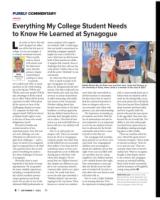
Rabbis Rachel Ain and Dave Levy and their sons, Jared and Zachary, at
the University of Texas, where Jared is a member of the class of 2027.