

8 | AUGUST 24 • 2023
PURELY COMMENTARY
column
Is Barbie Liberal or ‘Kenservative’?
I
n the 1950s, a Jewish
woman born in Denver,
Colorado, to parents who
fled persecution in Eastern
Europe, decided that the toy
market needed adult-themed
dolls for children.
Ruth Handler (1916-
2002) came up
with the idea
for “Barbie,”
named after
her daughter
Barbara and
reportedly
inspired by
“Bild Lilli,” a
German sex doll modeled
after a comic for the
German tabloid, Bild. A few
years later, Handler played
matchmaker and gave Barbie
a boyfriend, “Ken,” named
after her son, Kenneth. With
her husband, Elliot, and a
friend, Harold “Matt” Matson,
she co-founded Mattel Inc.,
the toy empire that released
Barbie to instant success.
The ironies in this
story are many: A Jewess
attuned to antisemitism
can credit a billion-dollar
idea to a post-war German
doll. Having started out
strawberry blonde, she
evolved into the most well-
known “stereotypical” Barbie:
that “all-American” whose
platinum-blond hair and
blue eyes might also classify
her as an “Aryan” (only with
American good cheer and
free spirit: Heidi Klum comes
to mind). Some analysts
argue that Handler’s “graven
image” was a sublimation of
a desire to assimilate into
America.
Or maybe it was just a
good business decision
that led to many more,
like starting a line of more
“ethnic” Barbies in the 1980s,
to the delight of “brown
girls” like me.
Columnists are desperate
to read philosophical,
political or social commen-
tary into the box-office
smash film Barbie. You
would think it’s the Torah
from the sheer number of
contradictory interpretations
it elicits.
Take, for example, Ben
Shapiro’s 40-minute tirade
(and essentially, commercial)
against the film as “woke
garbage.” A Twitter civil
war then erupted when
his Daily Wire colleague,
Michael Knowles, tweeted:
“It’s terrific. [Director] Greta
Gerwig is a genius. Ben is
completely wrong.” Knowles
defended the movie for its
affirmation of motherhood,
femininity and the need for
interconnectedness of the
two sexes.
They all seem to underplay
one major fact: Barbie was
co-produced by Mattel.
With the film, in which
Handler (played by Rhea
Perlman) imparts wisdom to
a distraught “stereotypical”
Barbie struggling with her
mortality (played by Margot
Robbie), Mattel simply
continued Handler’s tradition
of making excellent business
decisions, which included
hiring Israeli-American
businessman Ynon Kreiz as
CEO in 2018.
As reported in several
media interviews, he
envisioned leveraging
Mattel’s intellectual property
to ensure the company’s
liquidity and relevance.
In the movie, he’s played
by a goofy Will Ferrell in
an intentional act of self-
deprecation. A pro-Israel
Shapiro might have missed
that Israeli angle when he
literally burned a Barbie doll
in his video review.
Barbie is essentially a
glorified marketing campaign
for a “politically incorrect”
icon that idealizes beauty,
the feminine form (in an
exaggeration of proportions)
and heterosexual
relationships (although
Ken, as comically played
by a deliciously ripped
Ryan Gosling, is hyper-
metrosexual, at best).
Some feminists might
admire the Barbie brand for
asserting that women can be
anything. Other feminists
might praise “Astronaut
Barbie” but wail that there’s
no “Chubby Barbie.” (“Weird
Barbie” is hilariously
brought to life in the film,
but she’s the Barbie that
naughty girls rebelliously
burn and mangle). Non-
feminists will wonder why
there’s no “mother Barbie,”
and the discontinued
pregnant “Midge” doll is no
consolation for them.
In a very politicized world,
Barbie the doll would have
a severe image problem if a
film didn’t come along and
appear to grapple with her
problematic identity and
place in society. Mattel seems
to engage in introspection
about Handler’s creation,
especially through the
impassioned speech by
the Latina matriarchal
protagonist, Gloria (played
by America Ferrera) who
joins the campaign to save
“Barbieland” from a hostile
takeover by “Kens” pining for
“patriarchy.”
“It is literally impossible to
be a woman,” Gloria laments
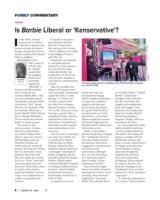
The pink carpet premiere of Barbie at the Pitt Street Mall in Sydney
on June 30, 2023.
EVA RINALDI OF ABBOTSFORD, AUSTRALIA, VIA WIKIMEDIA
COMMONS.
Orit Arfa
JNS.org