

AUGUST 17 • 2023 | 69
child’s sensibility, simultaneously
making his audience relive the
innocence of being a kid and
undermining it from an edgy
adult distance.
Thirty years later, I had anoth-
er disorienting Pee-wee moment.
I attended a screening of Nancy
Spielberg’s 2014 documentary on
American airmen who fought
in Israel’s war of independence,
Above and Beyond. Suddenly,
there was Paul Reubens again,
seated beside his mother and
explaining how his father, Milton
Rubenfeld, was an American
pilot who volunteered in the
fight for Israel. The film recounts
how his father flew in a critical
mission against the Iraqi army
and was shot down over the
Mediterranean (he survived).
“He was swaggering and
macho, like Indiana Jones,
”
Reubens says. “He felt like it was
his destiny.
”
I hadn’t even considered
until then that Reubens was
Jewish. In Why Harry Met Sally:
Subversive Jewishness, Anglo-
Christian Power, and the Rhetoric
of Modern Love (2017), one of
the few books about Jewish com-
edy in which Reubens appears,
Joshua Louis Moss groups him
with a cohort of Jewish comics
whose acts were “nearly com-
pletely devoid of references to
either their Jewish background
or Jewish culture more generally.
”
Paul Reubens died July 30,
2023, at age 70; a publicist said
he “privately fought cancer for
years.
” And even though his
career was derailed by scandal
— he was arrested for “exposing”
himself at a porn theater in his
hometown of Sarasota, Florida,
in 1991 — it’s not a stretch to
remember him as an heir to
the masterful comics who mined
Jewish comedy’s more anarchic
vein.
Like the Marx Brothers, Pee-
wee — with a crewcut, a too-
tight suit, a red bow tie and a
hint of lipstick and rouge — was
a costumed agent of chaos when-
ever he bumped against straight
(in all senses of the word) char-
acters. Like Jerry Lewis, his char-
acter seemed stuck in pre-ado-
lescence, but with an adult libido.
He could be as sexually ambig-
uous as Milton Berle in one of
his cross-dressing bits. And you
could even connect him to Baby
Snooks, the little-girl character
created by Fanny Brice of Funny
Girl fame.
HIS EARLY YEARS
Paul Rubenfeld was born Aug.
27, 1952, in Peekskill, New York,
and grew up in Sarasota. Milton
and his wife Judy (Rosen) owned
a lamp store. Milton Rubenfeld
had been a top fighter pilot who
served in the Royal Air Force,
and then the U.S. Army Air
Force, during World War II. He
became one of five Jewish pilots
who flew in smuggled fighter
planes and helped establish the
Israeli Air Force.
“When I was a youngster, they
seemed like fish stories to me,
”
Reubens recalled in the Spielberg
documentary. “I didn’t have any
real perspective on it until Ezer
Weizman [an Israeli Air Force
general and seventh president
of Israel], I believe, was the first
book that actually mentioned
my dad by name. And all of a
sudden, all these stories I’
d heard
my whole life growing up were in
this book. Once I actually knew
he really did all those things,
and then they weren’t things
everyone else did, I just had a
completely different view of [my
father].
”
After studying at Boston
University and the California
Institute for the Arts, Paul creat-
ed the Pee-wee character in the
late 1970s as a member of the
Los Angeles improv troupe The
Groundlings. HBO produced
a successful special starring the
character, and Pee-wee became
a cult figure, appearing on talk
shows and often confusing the
hosts with his child-like deliv-
ery and pansexual (or perhaps
pre-sexual) persona. (David
Letterman had him on his show
regularly but never seemed
completely comfortable in his
presence.)
His first feature film, Pee-wee’s
Big Adventure (1985) was direct-
ed by Tim Burton (who would
go on to direct Beetlejuice and
one of the best of the Batman
reboots) and was a financial and
critical hit. A sequel, Big Top Pee-
wee (1988), was less successful
but had its moments.
From 1986 through 1990,
Reubens starred in 45 episodes
of the CBS Saturday-morning
children’s program Pee-wee’s
Playhouse. It was both a chil-
dren’s show and a send-up of
a children’s show, featuring a
recurring cast of characters that
included a sea captain (Phil
Hartman), a cowboy (Laurence
Fishburne), a “mail lady” (S.
Epatha Merkerson) and a talking
chair. More than one critic noted
Reubens’ debt to Soupy Sales,
another Jewish comedian whose
1960s kids show also managed
to appeal to children as well as
adults who were in on the joke.
The indecent exposure arrest
led to a media frenzy that made
it impossible for Reubens to con-
tinue playing a children’s enter-
tainer. He eventually emerged
in a series of cameos and small
roles in film and television
shows — including a memorable
term as a grotesquely inbred
Hapsburg prince on 30 Rock,
and as a drunken Pee-wee oppo-
site Andy Samberg in a 2011
Saturday Night Live video.
In 2010, he revived the char-
acter that made him famous
on Broadway in The Pee-wee
Herman Show, and in 2016,
he co-wrote and starred in the
Netflix original film Pee-wee’s Big
Holiday.
Reubens kept his health issues
private. “Please accept my apolo-
gy for not going public with what
I’ve been facing the last six years,
”
he said in a statement distributed
by his publicist after his death. “I
have loved you all so much and
enjoyed making art for you.
”
In a 1987 Rolling Stone inter-
view, Reubens acknowledged
those who said his act built on
the Jewish comedians who came
before him, including Eddie
Cantor, the former vaudevillian
who played a frenetic, wide-eyed
innocent in a series of popular
movie comedies of the 1930s.
“Jerry Lewis I saw when I was
little,
” he said. “Soupy Sales I
probably saw when I was young-
er. I never knew who Eddie
Cantor was until years later,
when a lot of older people used
to go [in an old Russian-Jewish
furrier’s accent], ‘You’re like a
young Eddie Cantor.
’ I started to
watch Eddie Cantor, and I could
definitely see the resemblance.
His movies are just incredible,
very fantasy oriented and come-
dy oriented.
”
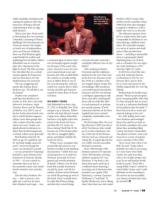
Paul Reubens
performs as Pee-
wee Herman in
Chicago in 1983.
PAUL NATKIN/GETTY IMAGES VIA JTA