

AUGUST 17 • 2023 | 61
DARK DOINGS IN THE
GARDEN STATE, ‘OPPY’
CORRECTIONS AND FUN
FACTS
Harlen Coben’s Shelter is
an eight-episode series
that begins streaming on
Amazon Prime on Aug.
18. New episodes stream
on successive Fridays.
Capsule plot: Mickey Bolitar
(Jaden Michael) is a teen
who moves to a small New
Jersey town following the
death of his father. He gets
tangled up in the disap-
pearance of a new student.
With the help of friends, he
realizes that the town has
a dark, long history of dis-
appearances, deaths and
legends.
As you might guess,
the series is based on
a novel by best-selling
author Harlen Coben, 60.
His first novel, Play
Dead (1990), was just
the first in a series of
big-selling mysteries and
thrillers. Coben grew up in
Livingston, New Jersey, and
was a childhood friend and
classmate of future New
Jersey Gov. Chris Christie.
In 2003, on Father’s Day
(6/15), the NY Times ran a
moving piece (The Key to
My Father) Coben wrote
about his beloved late
father. Among other memo-
ries, he recalled that during
his synagogue bar mitzvah
there was a short ceremony
in which a father blessed
his son. After the blessing,
he recalled his father whis-
pered in his ear how proud
he was of his son and how
much he loved him.
I finally saw Oppenheimer
last week and, after watch-
ing the film, I revisited
some things I wrote before.
By now, I figure that many
of you have seen the film
and you’ll like some more
bio details, mixed in with
corrections on a previous
column.
In my July 20 column,
I listed what appeared to
be the most prominent
(real) characters in the film.
I listed 20 characters and
12 of them were physicists.
I said that nine of the 12
were Jewish. I added that
all of them, except Einstein,
worked on the Manhattan
Project (the A-Bomb proj-
ect).
Here are my corrections
and some other stuff:
Danish physicist Niels
Bohr (1885-1962) was one
of the nine. Bohr had more
screentime than most
Oppenheimer characters.
As depicted in the film,
he declined an invitation
to work on the Manhattan
Project.
The film conveys Bohr
was a “giant” and without
his work, nuclear power,
etc., would have never
existed. However, I was
annoyed that his Jewish
background (his mother
was Jewish), was never
mentioned. The film did
show Bohr being welcomed
in America following his
escape from Nazi-occupied
Denmark. But it didn’t note
he fled (September 1943)
when he got the “word” he
was probably going to be
arrested because the Nazis
viewed the secular Bohr as
a Jew.
Bohr was smuggled out
of Denmark and taken on
a fishing boat to neutral
Sweden — and then on
to the States. Less than a
month later, most Danish
Jews (about 3,000) were
taken to Sweden in the
same way.
I said that I.I. Rabi
(1898-1988) worked on
the Manhattan Project. As
depicted in the film, he had
grave misgivings about
making the bomb. He
didn’t work at Los Alamos
but agreed to consult with
Oppenheimer when asked.
As depicted in the film, he
was at Los Alamos for the
first A-bomb test.
Rabi also had a lot of
screentime, and his and
Oppenheimer’s Jewish
backgrounds were made
clear in the same early
scene. What isn’t men-
tioned is that Rabi won the
Nobel Prize (1944) as WWII
raged. His prize was for
his discovery of nuclear
magnetic resonance. Unlike
many scientific discoveries,
Rabi’s discovery has led to
very practical things: the
invention of microwave
ovens, microwave radar
and magnetic resonance
imaging (MRI machines).
Rabi lived long enough to
have an MRI test. He said
that he saw his reflection
on the machine’s shiny
inside and he said to him-
self: “I never thought my
work would lead to this.”
I think the audience
would have welcomed
a “fact” scroll, after the
film ended, of information
about what happened to
the main characters. Like
the info I just wrote about
Rabi. Certainly, a post-
script on physicist Frank
Oppenheimer (J. Robert’s
brother) would have been
very nice. Frank was an
important film character.
I erroneously wrote
that Frank worked on the
Project. As depicted in the
film, he was a member
of the Communist Party
(1937-39) and that got him
barred from the Project.
The film mentions that he
was blacklisted after the
war. It doesn’t mention that
he made a huge career
comeback. He couldn’t get
a teaching job until 1959,
so he bought a cattle ranch
and ran it for 10 years. In
1967, he moved to San
Francisco and created the
Exploratorium, a hands-on
science, technology and
arts museum. It started
with a small-ish grant and
became, over time, a major
city attraction — and a
model for similar museums
all over the country. He was
the museum’s director until
his death in 1985, at the
age of 72.
CELEBRITY NEWS
NATE BLOOM COLUMNIST
ARTS&LIFE
BY CSWETONIC
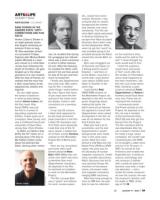
Harlen Coben
BY CSWETONIC
Niels Bohr
BY CSWETONIC
I.I. Rabi