

AUGUST 17 • 2023 | 59
At age 8, Strom began taking violin lessons
and never stopped honing his skills. He played
the violin all through high school and college,
becoming a violin virtuoso. “There was always
music in my house,
” says Strom, who is the
eldest of eight siblings. “It was always appreci-
ated and encouraged.
”
When Strom was 12 years old, his dad
accepted a professorship in education at San
Diego State University (SDSU) and the fam-
ily moved to California. His father, David, a
Wayne State grad, was one of the founding
members of the Chabad in San Diego.
Strom’s dedication to Judaism motivated
him to travel around the world, studying
and exploring Yiddish and Jewish cultures.
When he was a junior in college, he studied in
Sweden for a year, making connections in the
Jewish community and even leading a seder in
Uppsala, Sweden.
A LOVE OF KLEZMER
Strom went on to earn two undergraduate
degrees at SDSU and a master’s degree in
Yiddish studies at NYU. He was planning to
go to law school, but after hearing a band in
San Diego play klezmer music, he knew that’s
what he wanted to do.
“It was back in 1981 when klezmer was
just being revived in the United States,
” he
says. “I liked the music a lot — it was unlike
anything I had heard in shul. I went up to the
band leader, explained I was a violinist and
asked if I could join their group. They weren’t
interested, so I decided to form my own band.
But I wanted to be different from them, and I
wondered if there was klezmer music that was
unknown in the United States. I spent months
doing extensive research and wondered if
there were archives in Eastern Europe where I
could gather more information.
”
Strom flew to the Soviet Union, traveled to
Austria, Yugoslavia, Hungry, Romania and all
over the Eastern bloc, making connections
with Jews in those communities. It was there
he met Holocaust survivors, learned about
their relatives who perished in the camps, met
klezmer musicians and recorded their music
on his tape recorder. To earn money to live,
Strom would play the violin on the streets.
All his investigating paid off. Strom brought
attention to a klezmer music that had been
forgotten. He began writing about the music
and his travel experiences and people he met
along the way. Over the past three decades,
he has published 15 books, including The
Last Jews of Eastern Europe (1987), A Journey
Through the Jewish Culture of Eastern Europe
(2004), Uncertain Roads: Searching for the
Gypsies (1996), The Book of Klezmer: The History,
The Music, The Folklore (2002), and a children’s
book, The Wedding That Saved a Town (2008).
He has also penned a series called Shloyml
Boml; his most recent book, Sholyml Boyml
and His Purim Adventure, came out this past
spring. “My books are available in English and
Yiddish,
” he says. “Most of them can be found
on Amazon and Etsy as well as other places.
”
MAKING HIS MARK
Strom also made his mark in the film industry,
writing and directing films. He has directed
10 award-winning documentaries, including
The Last Klezmer (1994), A Letter to Wedgewood
(2013), and American Socialist: The Life and
Times of Eugene Victor Debs, Audience Favorite
Award at the Workers Unite Film Festival
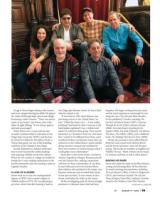
COURTESY OF YALE STROM
Yale Strom & Hot Pstromi
continued on page 60