

20 | AUGUST 17 • 2023
OUR COMMUNITY
M
ichigan’s synagogues
and temples began to
empty out and then
close on March 12, 2020, due to
the COVID-19 pandemic. The
70-member Michigan Board of
Rabbis took this action on the
advice of physicians to reduce
potential virus transmission
and illness. The Council of
Orthodox Rabbis of Greater
Detroit also issued guidelines for
their congregations.
It was a time of anxiety, along
with determination to maintain
synagogue life. Rabbis from
across the state, regardless of the
size or Jewish affiliation of their
congregations, faced the same
challenges — how to maintain
Jewish practices and connect
members while being physically
apart.
Judaism is founded on
a tradition of communal
observance, with a 10-person
minyan required for some
prayers, and group celebrations
such as Passover seders. The
pandemic inspired local rabbis
to quickly introduce new
methods of communication,
prayer and education. Some
of these innovations continue
today.
The transformation of
synagogue life was “utterly
traumatizing and an exciting
opportunity. It was fascinating
to figure out how to do this,
”
says Rabbi Aaron
Bergman of Adat
Shalom Synagogue,
a Conservative
congregation in
Farmington Hills.
Rabbis and
cantors, other staff
members and lay
leaders worked together to
communicate, facilitate new
ways of participating in religious
services and help members
who were especially vulnerable
during this time of isolation.
“It was one of the most
rewarding periods of time, and
one of the most exhausting
periods of time. There were
constant worries about people’s
physical and mental wellbeing,
and concerns about doing
enough to hold the community
together,
” says Rabbi Simone
Schicker of
Temple B’nai
Israel, a Reform
congregation in
Kalamazoo.
Being home
with their
families could be
stressful for some,
depending on the dynamics,
but some families enjoyed the
time together, observed Rabbi
Yechiel Morris of
Young Israel of
Southfield (YIS), a
Modern Orthodox
congregation in
Southfield. “People
are very resilient.
Some people could
cope, but others
thrived,
” he says.
TECHNOLOGY EXPANDS
Congregations stepped up their
use of technology, including
WhatsApp, Facebook, group
emails, Zoom and live-
streaming religious services.
Although Orthodox
synagogues do not permit
computer use on the Sabbath
or holidays, some used digital
technology at other times.
At YIS, the cantor led
congregants in songs online
before Rosh Hashanah and on
Fridays before Shabbat. Rabbi
Morris used WhatsApp to
post information and as a tool
for members to share things
that were happening in the
community.
Some larger congregations
were experienced in the use
of technology prior to the
pandemic, including live-
streaming Shabbos services,
while it was a new endeavor for
others.
The Chabad Lubavitcher
organization, which has multiple
Chabad centers in Metro
Detroit, has had robust internet
and video resources for 30 to
40 years, according to Rabbi
Shneur Silberberg, outreach
director of Bais Chabad Torah
Center in West Bloomfield. Bais
Chabad offers multiple online
classes daily, attracting a wide
range of students from all over
the country.
While technology expanded
opportunities it also presented
some challenges. “I never
What synagogues and temples learned from the COVID experience.
Synagogues Post-Pandemic
SHARI S. COHEN CONTRIBUTING WRITER
Rabbi
Aaron
Bergman
Rabbi
Yechiel
Morris
Rabbi
Simone
Schicker
CONGREGATION SHAAREY ZEDEK
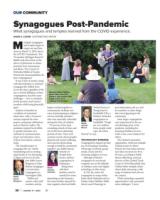
Shaarey Zedek Rabbis
Aaron Starr and Yoni
Dahlen, and Lindsay Mall
made music at an
outdoor Tot Shabbat.