

AUGUST 10 • 2023 | 17
continued on page 18
When did you decide
on a career in the labor
movement?
DH: I received my master’s
degree from the University of
Massachusetts and worked at
the Bureau of Labor Statistics,
where I was a steward with
the American Federation
of Government Employees.
Then, I worked toward a
Ph.D. at the University of
Wisconsin; thought I’d be
a professor and teach labor
studies. At Wisconsin, I
joined the Teaching Assistants
Association, American
Federation of Teachers Local
3220 (TAA), and eventually,
was elected its president.
While active in the union
in Wisconsin, I decided this
is what I wanted to do. Rather
than become a professor of
labor — important work
itself — I’d rather be directly
involved in building the labor
movement.
The TAA also had a major
impact on my personal life.
It is how my wife, Alice, and
I met. We married in 1986.
Alice continues her activist
career today. We have three
children: Joelle, Jose and
Gustavo. So, thank you TAA!
What was your first job in
the Labor movement beyond
the TAA?
DH: First job I got paid for?
I worked part-time for the
Allied Industrial Workers
(AIW) based in Milwaukee.
The AIW then got me a
job with the Michigan State
AFL-CIO in Battle Creek. I
subsequently moved on to
work at the Metro Detroit
AFL-CIO.
How did you become
president of AFT Michigan?
DH: When I walked into the
TAA office in Wisconsin in
1977, I never thought that I
would end up as the 22-year
president of American
Federation of Teachers (AFT)
in Michigan [laughs] or a
national AFT vice president.
In 1996, after working at
the Metro Detroit AFL-CIO
for 10 years, Hugh Jarvis, the
president of what is now called
AFT Michigan, told me he
was stepping down, that Rollie
Hopgood would become
president so why don’t I come
over and serve as Rollie’s
administrative assistant. I did
and, when Rollie retired in
2001, I ran for president and
won.
Tell me about leading a
union. How would you
summarize your position?
DH: Our state union
represents about an equal
number of Pre-K-12 and
higher education employees
with a fast-growing health care
worker group. As president,
you’re involved in everything:
building strong local unions,
political and legislative
action, organizing, policy
work, trainings, community
involvement and helping
to build the progressive
movement. We have a great
staff that I was honored to
work with.
K-12 public education has
experienced tremendous
change over the past several
decades — digital learning,
COVID, charter schools,
etc. Some say computers will
replace teachers, and that
will be for the best. What is
your analysis of the status of
public education?
DH: K-12 public education
is the foundation of our
democracy. It provides
hope and opportunity for
our children. Tremendous
work is going on in public
education, although even with
Gov. Gretchen Whitmer’s
historic increases, funding for
education is inadequate. Are
there places where academic
achievement needs to improve,
in some places significantly?
Yes. And our union does much
work advancing research-
based policies and practices so
that our children, regardless
of zip code, receive a great
education.
Teachers often get blamed
for all problems facing public
education, but the real culprit
is perpetual underfunding.
This underfunding, and the
trend of falsely assigning
blame, are the major reasons
we have a serious teacher (and
support staff) shortage today.
Moreover, poverty often
creates barriers that prevent
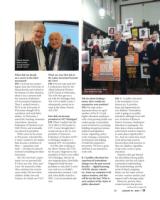
David Hecker
with former
Congressman
Sandy Levin
David Hecker at an “End
Gun Violence” rally