

14 | JULY 27 • 2023
Y
om HaShoah, Holocaust
Remembrance Day, is a day set
aside to remember and honor
the 6 million Jewish victims of the Nazis.
The national holiday in Israel, commem-
orated in Jewish communities worldwide,
began this year on the evening of April 17.
Communal programs held on or near the
date included appropriate recitations and
memorial candle-lightings.
For anyone personally affected, howev-
er, one solemn day of remembrance each
year is not nearly enough. The unprec-
edented murders and loss of family in
Europe constitute a tragedy that forever
looms over Holocaust survivors and their
descendants. Whether discussed openly
or kept hidden, the experiences of Shoah
survivors made the families they headed
different than other Jewish families. Their
children (2Gs), being closest to their par-
ents’ trauma, grew up feeling its effects in
both negative and positive ways.
A group of 2Gs living in Ann Arbor
decided to write a book about their survi-
vor parents and the impact on themselves
and other family members. The 16 per-
sonal essays contributed are the heart of
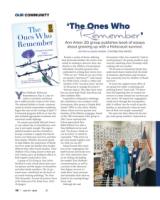
an award-winning anthology, The Ones
Who Remember: Second-Generation Voices
of the Holocaust (City Point Press, 2022;
334 pages).
Despite a variety of factors defining
their particular families, the writers were
united in wanting to discover their own
identity as the children of traumatized
individuals. Essential questions they
confronted in writing their stories were
“‘Who are we?’ ‘What do we carry from
our parents’ experiences?’” said essayist
Joy Wolfe Ensor, a book co-editor and
member of the “executive team,” elected
by the group to manage the project’s
business aspects. The other team mem-
bers are chair Ruth Wade, Rita Benn and
Julie Goldstein Ellis.
Long before writing their anthology,
the contributors were members of the
Generations After group at Temple Beth
Emeth (TBE) in Ann Arbor. Martha
Solent, whose survivor parents were
founders of the Reform synagogue, found-
ed the TBE Generations After group in
2003. Ensor reported that
Solent approached then-
Rabbi Robert Levy after a
Yom HaShoah service and
said, “You know, I think we
can do better,” to which he
responded, “‘Why don’t you
get some people together and
see what you can do?”
Solent located other mem-
bers of the congregation she
hadn’t known previously were
2Gs. They shared her inter-
est in writing and leading
the temple’s Yom HaShoah
commemoration, as well as
a portion of the afternoon
Yom Kippur services, to
make them “more personal
and immediate than what we
found in the existing liturgy,”
Ensor said.
Although she said
Generations After was created for “task-fo-
cused purposes,” the group members expe-
rienced a satisfying sense of kinship while
working with one another.
“We became an intentional family that
understood almost instinctively the kinds
of situations, deprivations and emotions
that commonly arise for children of Shoah
survivors.
“It wasn’t the original raison-d’être of
our group, but rather a surprising and
enduring bonus,” Ensor said. “We knew
from the beginning that we wanted our
services to center around our survivor par-
ents’ stories. We hoped our congregation
would move through the incomprehen-
sible ‘6 million’ into the world of specific
families, as introduced to them by mem-
bers of their own temple community.”
Ten years into their efforts for the tem-
ple, some group members “expressed an
Ann Arbor 2G group publishes book of essays
about growing up with a Holocaust survivor.
ESTHER ALLWEISS INGBER CONTRIBUTING WRITER
OUR COMMUNITY
Book author Ava Adler,
Esther Allweiss Ingber,
and book authors Joy Wolfe
Ensor and Eszter Gombosi