

4 | JULY 20 • 2023
essay
How a Christian Holocaust
Scholar Became a Jew
A
fter a life spent
studying and
working with the
Jews, Stephen Smith became
one.
You would
think then that
Smith, with his
international
reputation as
a scholar and
archivist of
the Holocaust,
would now be joining the
chorus of voices warning
us that antisemitism is
an existential threat to
American Jews.
You would be wrong.
Smith’s journey to Judaism
has, if anything, given him
insights on how to fight, and
beat, antisemitism.
Smith was born and
raised in Nottinghamshire,
England, the son of devout
evangelical Christians. On
their first family trip to
Israel in 1980, when he was
13, Smith was struck by the
sight of Jews praying at the
Western Wall.
“I thought, we came
here to study the origins
of Christianity. When
we get here, I see Jewish
people praying where
Jesus of Nazareth would
have come. How come I
don’t understand what I’m
seeing?”
Ten years later, after
studying Christian and
Jewish theology in university,
Smith considered converting
to Judaism.
He contacted an Orthodox
rabbi, who struck him as
too stringent, and a Reform
rabbi, who seemed “too
cold.”
“I was having a Goldilocks
moment,” he told me.
At the time, Smith decided
he could do more to combat
antisemitism by remaining
Christian.
“This happened to
the Jews,” he said of the
Holocaust, “but it was not
the making of the Jews. This
was a product of Western
European civilization.” His
leverage, he said, came from
being part of the majority.
Smith went on to create,
with his brother James
and their mother Marina,
England’s National Holocaust
Museum and Centre, which
he ran from 1995 until
coming to Los Angeles in
2009 to head up the USC
Shoah Foundation, founded
in 1993 by director Steven
Spielberg to preserve
videotaped testimony of
Holocaust survivors.
There, Smith expanded
the distribution of the
foundation’s 56,000
Holocaust testimonies to
schools around the world,
collected testimony from
survivors of the Rwandan
and other genocides, and
pioneered the use of AI and
holograms for presenting
survivors as if they were alive
in museum settings.
THE JOURNEY TO ‘US’
After he stepped down from
the USC Shoah Foundation
in 2021, Smith traveled to
Israel for one of, by then,
many regular visits. This
time, at the Western Wall
— where he sat five decades
before — something shifted.
For the first time in his
life, he said, he was no longer
a professional “representing
6 million souls,” fighting
antisemitism in their
memory.
“I thought, why do I have
to sit on the outside looking
when I feel a part of this
history? Why wouldn’t I
want to be a part of this
people and its history?”
When his wife, Heather
Maio-Smith, who is Jewish,
returned from her prayers
at the women’s section, he
turned to her and said, “I’m
going to convert to Judaism.”
Maio-Smith looked at her
husband in shock. “What,
now?”
Later that day, Smith
called Rabbi Neal Weinberg,
a Conservative Los Angeles
rabbi who offers conversion
classes, and signed up.
He went through the
classes and began studying
for conversion with Rabbi
Adam Kligfeld of Temple
Beth Am, a Conservative Los
Angeles synagogue. He also
started celebrating Shabbat
at home.
What changed for Smith,
who now runs an AI
company that he and Maio-
Smith founded, wasn’t an
increase in actual Jewish
knowledge.
“I’m not saying I could
have taught the conversion
course,” he said, “but not far
off.”
The change was more
subtle, and more striking.
Rob Eshman
Forward.com
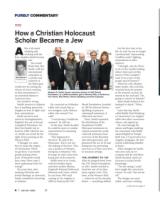
Stephen D. Smith, former executive director of USC Shoah
Foundation, at a 2018 foundation gala in Beverly Hills, is flanked by
Tom Hanks, Rita Wilson, Steven Spielberg and Kate Capshaw.
PHOTO BY GETTY IMAGES/FORWARD.COM
PURELY COMMENTARY
continued on page 7