

JULY 20 • 2023 | 25
Teaching throughout the fall at Michigan
State University will carry the performers
into the end of their yearlong visit to the
United States.
“Many of our presentations are going to
be hands-on workshops for smaller groups
and are mainly translations of Israeli paint-
ings into eating experiences,
” Bar said. “
A
group looks at a painting by Israeli artists,
and we make an interpretation into a dish.
This is mainly going to be the activity in
Michigan.
”
The duo met some 10 years ago in
Jerusalem while Evyatar studied industrial
design at Bezalel Academy, and Bar was
studying different disciplines at the School
of Visual Theatre, where students are
taught to combine various aspects of stage
disciplines as they establish their careers.
For about eight years, the two have made
presentations in Israel and have solicited
responses from their audiences.
“Most of the time, we don’t bring
Judaism consciously into the performance,
”
Evyatar said. “Judaism, though, is a con-
tinuing part of our culture. Because we are
Jewish and Israeli, Judaism is present.
“Sometimes, we like to take the Bible and
use it as a storybook interpreted in a culi-
nary way. We use it almost as a cookbook.
”
The women, who also share family
life with infant twins, have brought their
children with them to the United States.
A favorite activity is looking for farmers’
markets with the idea of expanding the chef
aspects of what they do on stages.
“We like to go hiking by a lake or a river,
”
Bar said. “In Israel, it’s rare to see so much
water. We’re always amazed to see how
much water we can find in this area. Of
course, we also like good restaurants and
good food.
”
The two explained that they prepared for
this stream of travel presentations by look-
ing around them and seeing lots of nature
in different ecosystems prominent in every
area of Israel.
The different vegetation prompted them
to focus on nature at the various events
where they are being featured, and they
traveled Israel from north to south, hiking
and foraging and getting to have direct
experiences for what grows in Israel.
“BAMAH made all the connections for
where we appear, and we couldn’t have it
without them,
” Bar said. “They did a hard
job and found great communities for us.
”
Other family members of the two women
also are active in the Israeli entertainment
industry, they have said. Two accept differ-
ent areas of directing and stage design.
“We have found that United States audi-
ences are very engaged with what we do,
”
Evyatar said. “I feel Americans really want
to know what we’re thinking about. They
are curious and ask lots of questions.
”
The pair welcomes those questions.
“I want audiences to think of the ques-
tions of what is the flavor of their favorite
place in the world, what is the flavor of
their hometown and what is the flavor of
Israel,
” Evyatar said. “I hope we help make
people more aware of their many senses.
”
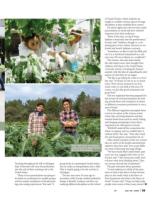
Michal Evyatar
and Carmel Bar
From “Soil Food,” an ongoing
project started in 2020. Carmel
Bar and Michal Evyatar.