

Looking Back
From the William Davidson Digital Archive of Jewish Detroit History
accessible at www.djnfoundation.org
54 | JULY 6 • 2023
‘Badge of Honor’
W
e have no flag, and we need one. If we desire to lead many men, we must raise a
symbol above their heads,” Theodor Herzl declared in 1896 in his landmark essay
Der Judenstaat. He was referring to a flag as an emblem for a future State of Israel:
“For we shall march into the Promised Land carrying the badge of honor.”
Herzl’s plea for a Zionist flag would be fulfilled. Today, Israel has a distinctive national flag,
easily recognized, which was adopted by the new state on Oct. 28, 1948. It features a Magen
David or Star of David in the center of a white flag with two horizontal blue stripes. Note that
the basic design resembles a tallit, a Jewish prayer shawl, which is white with black or blue
stripes.
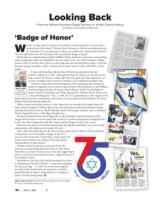
A blue and white flag with the Star of David was adopted at the first
Zionist Conference in 1897. Although Herzl got his flag, it was not the one he
had in mind. He desired a white flag with seven gold stars that indicated a sev-
en-hour workday, which would be symbolic of an enlightened modern state.
I started to think about the development of the Israeli flag after finding an
article by legendary Jewish Chronicle and JN editor, Phil Slomovitz, in the William
Davidson Digital Archive of Jewish Detroit History. Titled “Israel’s Badge of
Honor: History of the Blue and White Flag and Dr. Theodor Herzl’s Dream of a
7-Hour Working Day” (Oct. 1, 1948, JN), it is a good history of the origins of the
Israeli flag. It notes the contributions and claims of such people as David Wolfson, Dr. Israel
Belkind and Jacob Baruch Askowith.
What is most interesting, however, is that Slomovitz was writing a few weeks before the
State of Israel adopted its official flag. In fact, the Israeli government had solicited designs
and had received 164 entries. Moshe Shertok, Israel’s first foreign minister, even resubmitted
Herzl’s original idea for a white flag with gold stars.
Slomovitz predicted that “Israel’s flag will, in all probability, retain the features of the
ensign that has been in use for nearly half a century in Jewish communities throughout the
world: the white background with blue stripes and the Magen David in the center.”
Slomovitz was spot-on. Israel did indeed adopt the flag that had flown over many Jewish
communities and institutions for nearly 50 years.
Since 1948, the Israeli flag has also flown many, many times in Detroit. It was published
on hundreds, if not thousands, of pages in the JN. A
search in the Archive for “Israeli Flag” raised nearly 700
articles that cited the term. Images of the flag appear
with hundreds of other articles.
Debates within the Jewish community about why
and where an Israeli flag should be flown in the United
States have occurred. In some cases, it has also triggered pro-
tests by anti-Israel and antisemite forces, simply because it is
the symbol of Israel.
Nevertheless, the flag of the Jewish homeland has flown
at celebrations of Israel in Detroit — most often alongside
an American flag — as well as at events that recognize
the deep Israeli-Jewish Detroit connection. As Herzl
hoped, the flag of Israel is indeed flown as a “badge of
honor” for the Jewish people.
Want to learn more? Go to the DJN Foundation archives, available
for free at www.djnfoundation.org.
Mike Smith
Alene and
Graham Landau
Archivist Chair