

38 | JULY 6 • 2023
A
true story that took
place in 1995: It con-
cerns the legacy of an
unusual man with an unusual
name: Mr. Ernest Onians, a
farmer in East Anglia, England,
whose main business was as
a supplier of pigswill. Known
as an eccentric,
his hobby was
collecting paint-
ings. He used
to go around
local auctions
and whenever a
painting came on
sale, especially if
it was old, he would make a bid
for it. Eventually he collected
more than 500 canvases. There
were too many to hang them
all on the walls of his relatively
modest home, Baylham Mill
in Suffolk. So, he simply piled
them up, keeping some in his
chicken sheds.
His children did not share
his passion. They knew he was
odd. He used to dress scruffily.
Afraid of being burgled, he
rigged up his own home-made
alarm system, using klaxon
horns powered by old car bat-
teries, and always slept with a
loaded shotgun under his bed.
When he died, his children
put the paintings on sale by
Sotheby’s, the London auction
house. Before any major sale of
artworks, Sotheby’s puts out a
catalogue so that interested buy-
ers can see in advance what will
be on offer.
A great art expert, Sir Denis
Mahon (1910-2011), was look-
ing through the catalogue one
day when his eye was caught by
one painting, in particular. The
photograph in the catalogue,
no larger than a postage stamp,
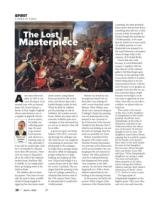
showed a rabble of rampaging
people setting fire to a large
building and making off with
loot. Onians had bought it at a
country house sale in the 1940s
for a mere 12 pounds. The cat-
alogue listed the painting as the
Sack of Carthage, painted by a
relatively little-known artist of
the 17th century, Pietro Testa.
It estimated that it would fetch
15,000 pounds.
Mahon was struck by one
incongruous detail. One of
the looters was making off
with a seven-branched cande-
labrum. What, Mahon won-
dered, was a menorah doing in
Carthage? Clearly the painting
was not depicting that event.
Instead, it was a portrait of
the Destruction of the Second
Temple by the Romans. But if
what he was looking at was not
the Sack of Carthage, then the
artist was probably not Testa.
Mahon remembered that
the great 17th century artist
Nicholas Poussin had painted
two portraits of the destruction
of the second temple. One was
hanging in the art museum in
Vienna. The other, painted in
1626 for Cardinal Barberini,
had disappeared from public
view sometime in the 18th
century. No one knew what had
happened to it. With a shock,
Mahon realized that he was
looking at the missing Poussin.
At the auction, he bid for the
picture. When a figure of the
eminence of Sir Dennis bid for
a painting, the other potential
buyers knew that he must know
something they did not, so they
too put in bids. Eventually Sir
Dennis bought the painting for
155,000 pounds. A few years
later he sold it for its true worth,
4.5 million pounds, to Lord
Rothschild who donated it to
the Israel Museum in Jerusalem
where it hangs today in the
memory of Sir Isaiah Berlin.
I know this story only
because, at Lord Rothschild’s
request, I, together with the
then director of the national
gallery, Neil MacGregor, gave
a lecture on the painting while
it was shown briefly in London
before being taken to its new
and permanent home. I tell the
story because it is so graphic an
example of the fact that we can
lose a priceless legacy simply
because, not loving it, we do
not come to appreciate its true
value. From this we can infer a
corollary: we inherit what we
truly love.
This surely is the moral
of the story of the daughters
of Zelophehad in this week’s
parshah. Recall the story:
Zelophehad, of the tribe of
Manasseh, had died in the
wilderness before the alloca-
tion of the land. He left five
daughters but no sons. The
daughters came before Moses,
arguing that it would be unjust
for his family to be denied
their share in the land simply
because he had daughters
but not sons. Moses brought
their case before God, who
told him: “What Zelophehad’s
daughters are saying is right.
You must certainly give
them property as an inher-
itance among their father’s
relatives and give their father’s
inheritance to them” (Num.
27:7). And so it came to pass.
The Sages spoke of
Zelophehad’s daughters in the
highest praise. They were, they
said, very wise and chose the
SPIRIT
A WORD OF TORAH
The Lost
Masterpiece
Rabbi Lord
Jonathan
Sacks