

HEALTH
T
rauma has a tremendous physical
and/or emotional impact on vic-
tims, but it’s important to remem-
ber the effect it has on first responders
like police and EMS as well.
Ayelet Shmuel of The Resiliency Zone,
an Israel-based mental health practice
that specializes in healing trauma, works
with organizations around the world on
trauma training, including Jewish organi-
zations in Metro Detroit.
The reason being: society often “miss-
es out” on mental health care for first
responders, Shmuel, 50 of Ashkelon,
Israel, explains. Living in a war zone that
often sees rockets, Shmuel has learned
firsthand the impact that support for first
responders can have.
Still, the need for mental health care
for first responders goes beyond Israeli
tensions.
As the world grapples with a spike
in mass shootings, with 202 in the U.S.
alone in 2023, including the Michigan
State University shooting that left three
students dead, first responders — who are
directly on the front lines — shoulder a
massive emotional impact.
It’s why Michigan Hatzalah, a Jewish
volunteer service that provides rapid
response to medical emergencies, enlisted
Shmuel’s help last fall for training on how
to identify and prevent PTSD amongst
first responders, a very real and often
invisible side effect of the job.
A GROWING CRISIS
Recent studies show that about 10% of
first responders report PTSD, or post-
traumatic stress disorder, a mental health
condition triggered by witnessing a trau-
matic event. Other data puts that number
much higher — up to 35%, depending on
the job.
While PTSD and symptoms can look
different from person to person, first t
Recent studies show that about 10% of
first responders report PTSD, or posttrau-
matic stress disorder, a mental health con-
dition triggered by witnessing a traumatic
event. Other data puts that number much
higher — up to 35%, depending on the job.
While PTSD and symptoms can look
different from person to person, first
responders can experience emotion-
al numbing and avoidance, which can
impact personal relationships. It can also
include depression, anxiety and substance
use or abuse.
Not everyone will go on to develop
PTSD, but Shmuel says being aware of
the signs, and knowing how to prevent it
from occurring, can be an effective way to
bring down rising numbers of PTSD in an
increasingly violent world.
In the recent program for Michigan
Hatzalah, for example, Shmuel worked with
first responders to teach practical tools to
protect and care for their mental health,
while simultaneously caring for victims.
“People in these jobs usually have a good
ability to go from zero to 100 and go into
action mode and crisis mode,” Shmuel
says. “These are usually people that you
How the community
can help prevent
PTSD amongst police,
firefighters and EMS.
Prioritizing Mental
Health Care for
First Responders
continued on page 37
36 | JULY 6 • 2023
ASHLEY ZLATOPOLSKY
CONTRIBUTING WRITER
Ayelet Shmuel
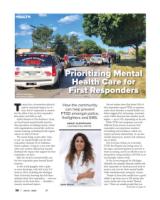
Hatzalah Michigan
volunteers in action.