

JUNE 22 • 2023 | 41
continued on page 43
F
ifty years ago, a new kind of book
appeared in the Jewish world: a
practical, hands-on guide for how to
do Jewish things. The First Jewish Catalog:
A Do-It-Yourself Kit provided advice and
encouragement to readers to take action,
instead of waiting for some expert. The
short articles explain how to crochet a kip-
pah, build a sukkah, make your own wine,
wind your tefillin, set up your kosher kitch-
en, tie your own tzitzit and do pretty much
anything else.
If you felt not up-to-the task — as many
Jews did — the book gave you permission
to try. The Catalog — including its succes-
sor editions — sold about a half-million
copies. Clearly, a lot of Jews felt inadequate-
ly prepared but eager to do Jewish acts.
One of the editors of the Jewish Catalog,
Michael Strassfeld, went on to a long
career as Jewish educator and rabbi. Now
Strassfeld has written Judaism Disrupted: A
Spiritual Manifesto for the 21st Century (Ben
Yehuda Press, 2023), aimed at another audi-
ence, or rather, two different audiences.
Strassfeld explains: “One is people
involved in the Jewish community, hap-
pily active in the Jewish community, who
somehow feel that their Jewish life is lack-
ing. They may belong to a synagogue, and
even attend sometimes, but they just don’t
feel very satisfied with the services.
“
And the other,” he adds, “people at the
margins or beyond the margins. People
who say, ‘I am a mediocre Jew’ or a ‘bad
Jew.’ People who find Jewish practice unfa-
miliar and who just are not that interested.”
Those people feel like they do not, or
would not, get what they want from Jewish
practice. The flaw, for Strassfeld, lies in
trying to “understand Judaism as a system
of law and obligation.” Rather, he says, “the
contemporary moment calls for something
radically different.”
Strassfeld believes that we can choose to
engage in Judaism to create a meaningful
life, committed to inner spiritual work
and social justice, as part of a sustaining
community. The key involves understand-
ing observances as spiritual practices.
“Judaism is actually about how to live a life
of freedom,” he says, quoting the 19th-cen-
tury Chasidic work, Sefat Emet. We, like
the early Chasidim, can invest meaning in
our practices by cultivating our intention
(Hebrew kavannah). We might need the
discipline of practice, but our real growth
comes from mental work.
“It is kavannah, the intention of the
heart and mind, which gives these precepts
meaning,” he writes.
For example, Strassfeld sees how much
matzah to eat as not an important ques-
tion. Eating matzah with awareness can
lead us to valuing our own freedom and to
working to help others who lack freedom.
Not eating matzah “would not be a betray-
al of God or the Jewish people. It would be
a loss to our spiritual life not to remember
the story of the Jewish people,” he says.
JEWISH PRACTICE
In total, Strassfeld presents 11 core princi-
ples that Jewish practice can embody:
Equality: Seeing others as equals
because we are all created in the image of
God, who, paradoxically, has no image.
Morality: Striving to make the world
better accords to the universe.
Awareness: Developing our awareness
leads us to freedom; unawareness, to slavery.
Freedom from: Working for freedom for
others, aiming for social justice.
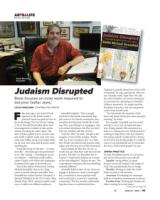
Judaism Disrupted
Book focuses on inner work required to
become ‘better Jews.’
LOUIS FINKELMAN CONTRIBUTING WRITER
ARTS&LIFE
BOOK REVIEW
Rabbi Michael
Strassfeld