

22 | JUNE 8 • 2023
OUR COMMUNITY
L
ots of jewelers cut
and polish stones and
set them into rings,
pendants and earrings. But
few dig the stones out of the
earth themselves.
Nick Liebowitz travels
to Nevada every year to
find gemstones in a mine
controlled by a friend.
His friend owns a “stake”
— the state of Nevada owns
the land — that allows him
to excavate, and Liebowitz
usually spends a day or two
with him once or twice a
year searching for stones.
The men use a backhoe
to scrape off the dry top
layer of earth. They move
large rocks aside with pry
bars and crow bars. Then
they start looking for “pay
dirt,” moister soil that
indicates the likely presence
of minerals. They explore
the pay dirt with chopsticks
and screwdrivers, digging
out nuggets that range from
a half-inch to several inches
in diameter.
Liebowitz finds mostly
amethyst, quartz and smoky
quartz and, occasionally,
citrine. He’s heard there is
“gold in them thar hills,” but
he’s never found any.
Back home in Farmington
Hills, Liebowitz cuts and
polishes the gems and
usually etches a design on
the back, which appears
three-dimensional from the
front because of the stone’s
faceting.
Liebowitz, 35, started out
on a more conventional
path. A graduate of North
Farmington High School, he
enrolled in the College for
Creative Studies in fine arts
and graphic design. After
one year, he transferred
to Wayne State University,
where he studied business
for a few semesters before
deciding that “school wasn’t
really for me.”
He made his way to
California and worked for a
friend who had a company,
Third Eye Pinecones, and
who made jewelry out of
cross-sections of pinecones.
That was Liebowitz’s intro
to the world of jewelry and
gemstones. He started going
to shows and learning more
about precious and semi-
precious stones and about
jewelry-making.
Then another friend took
him to the mine in a place
called Hallelujah Junction
in western Nevada, about
an hour west of Reno on the
California border.
Liebowitz says he has to
dig for only a few hours to
collect a boxful of stones,
enough to keep him busy
for many months.
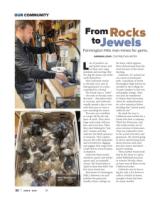
Farmington Hills man mines for gems.
Rocks
From
toJewels
BARBARA LEWIS CONTRIBUTING WRITER
Nick Liebowitz cuts
gems.
Nick’s latest haul of
gems