

18 | JUNE 8 • 2023
A
s the daughter of
Soviet Jewish immi-
grants and first in my
family to be born in the United
States, I’ve long been fascinated
with the Soviet Jewish immi-
gration story.
How did an estimated nearly
2 million Jews and their rela-
tives emigrate from the Soviet
Union since 1970 — as a slow
trickle and then en masse
— and manage to start new
lives in the U.S., Canada and
Australia, among other coun-
tries?
The why is well-known.
Antisemitism and limited edu-
cational and career opportuni-
ties for Soviet Jews left many
wanting a better life for them-
selves or their children. Yet the
process of actually leaving the
USSR, and the steps that fol-
lowed, can often be a mystery
unless you’re lucky enough to
have relatives who can tell the
story in detail.
While I managed to establish
most of my family’s immigra-
tion story through extensive
interviews (and endless ques-
tions) that as a journalist I
was able to ask my parents, I
still had many pockets of the
storyline that just didn’t have
enough information.
Luckily, information housed
in the JDC Archives, the
archives of the American Jewish
Joint Distribution Committee, a
Jewish relief organization, were
able to answer many of those
lingering questions for me.
FILLING THE BLANKS
As one of several Jewish organi-
zations involved in relief efforts
for the rescue of Soviet Jews
from 1970 onwards, and in the
many decades that preceded
that, JDC’s extensive archives
hold photographs, a names
index and more from this criti-
cal time period.
(Still, I’m just naming one
example of what the archives
include — there are records
from all areas of JDC’s work,
which operates in 70 countries
around the globe.)
While some information
is public and searchable in
the JDC archives database,
there are also private transmi-
grant case files on Soviet Jews
assisted by JDC available to
family members only. These
files contain information from
Vienna and Rome, two stops
on the Soviet Jewish pipeline
that served as important tran-
sit points for the immigration
process.
Since I was able to find my
family in the names database,
I reached out to JDC archivist
Misha Mitsel, a Ukraine native
and Soviet Jew assisted by JDC
himself, to inquire what infor-
mation JDC might have on my
family.
As it turns out, JDC had
transmigrant case files on
each bucket of my fami-
ly — my father’s family, my
mother’s family and then my
great-grandparents, who emi-
grated separately — and I was
able to purchase the files.
Typically, these files cost $50
a piece, but Abby Lester, JDC’s
director of the global archives,
says the organization will work
with you on a fair price. If one
file is smaller, for example, and
only has two pages, they won’t
charge you $50.
Each case file I received
was vastly different from the
OUR COMMUNITY
Tracing my Family Tree
JDC Archives hold treasure trove of
family history information for Soviet Jews.
ASHLEY ZLATOPOLSKY CONTRIBUTING WRITER
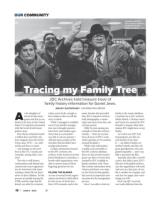
Families welcome
their Soviet relatives
to Detroit in this
historical photo.
JFS