

50 | MAY 25 • 2023
ARTS&LIFE
BOOKS
P
eople expect Jews to tell subversive
jokes that only seem innocent,
that imply disrespect for authority
and that might leave a bitter aftertaste. For
generations, scholars have tried to explain
what Jewishness has to do with producing
snarky comedy. Sigmund Freud wrote
about it, and Rabbi Joseph Telushkin,
professors Jeffrey Dauber and
Ruth Wisse, and many more.
Now, Professor Jennifer
Caplan has added to the
scholarly efforts to understand
Jewish humor in her new book
Funny, You Don’t Look Funny:
Judaism and Humor from the
Silent Generation to the Millennials (Wayne
State University Press, 2023).
Perhaps the most widely accepted theory
of Jewish humor starts with a downtrodden,
disrespected minority in Eastern Europe,
able to rebel against the powerful only with
veiled hostility. My Aunt Frances located an
earlier source: biblical Jews giving Moses
a hard time with the sarcastic question,
“
Are there no graves in Egypt that you
took us out to die in the desert?” (Exodus
14:11) Jewish sarcastic irony started at our
beginning.
For whatever reasons, as the American
entertainment industry grew in Hollywood
and New York, Jewish writers produced
much of the comedies. Jennifer Caplan
adds a significant angle to the enormous
collection of scholarship about Jewish
humor by focusing on how specific comic
works fit into the tasks of the Jewish
community in America from the mid-20th
century until close to the present.
In the early 20th century, immigrants and
their children made up the largest share of
America’s Jews. They faced the challenge
of becoming American enough to survive
in their new land. Humor by
Jews and about Jews — like
humor about other ethnic
groups at the time — tended
toward cruel mockery of
stereotyped immigrants.
These comic works
exemplify Thomas Hobbes’
“superiority theory”
of humor: Laughter comes from
recognizing yourself as part of the in-group
at the expense of the out-group.
THE NEXT GENERATION
OF HUMORISTS
Caplan’s study begins at the next stage, with
humorists who “were too young to fight in
World War II.
” She calls these “The Silent
Generation,
” who “wish to preserve, and
even protect, the Jewish people,
” but by
discarding Jewish faith.
As a prime example of this tendency,
she presents Woody Allen’s 1970 Hassidic
Tales, with a Guide to Their Interpretation
by the Noted Scholar, a riff off the Tales of
the Hasidim by Martin Buber. Allen’s work
serves as a Midrash on a serious Jewish text,
but a subversive Midrash. In Caplan’s words,
Allen presents “sacred text” as a “ridiculous
notion.
” The rabbis offer idiotic advice, and
the Jews should have known better than
to ask them. Allen, Caplan summarizes,
believes “Jewish texts are not worth the
paper they are printed on … and religion is
a burden to its members.
” I do not see that
Allen expresses the wish to “protect … the
Jewish people.
”
Caplan’s next chapter, “Silent No More,
”
oddly enough focuses on earlier writers
who condemn Americanizing Jews for
turning their backs on the Jewish people.
American Jews fail when confronted with
the needs of fellow Jews in distress. Caplan
presents Philip Roth’s 1959 story, Eli, the
Fanatic, in this context. Upwardly mobile
suburban Jews ask Roth’s protagonist,
Eli Peck, a young lawyer in their
neighborhood, to prevent an embarrassing
threat to their American identity. A
Chasidic survivor wants to open a yeshivah
in their town for 18 young survivor
orphans. What would the Protestants think
if they saw Jews dressed in Old World
clothing? Spoiler alert: Eli comes to respect
the Chasid, and Eli’s community decides Eli
needs medical intervention. In this story,
Roth shows no affection for Jewish ritual
or belief, but he does reveal his “wish to …
protect the Jewish people.
” Caplan sees this
as typical of the “silent no more” generation.
THE COPYCATS
Caplan presents the next decade of Jewish
comics, the baby boomers, as “The Copycat
Generation.
” Jews have become comfortable
in America and now feel the need to
reevaluate Jewish ritual. Jewish humor in
America had generally avoided focusing
on Jewish ritual until now, according to
Caplan. In a famous skit in 1977, Saturday
Night Live presented a fake commercial for
a fancy car, “Royal Deluxe II.
” The car gives
such a smooth ride that “Rabbi Taklas” can
circumcise a baby in the car while riding
over rough pavement. The rabbi concludes
the segment, exclaiming “That’s a beautiful
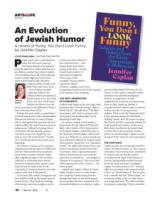
A review of Funny, You Don’t Look Funny
by Jennifer Caplan.
An Evolution
of Jewish Humor
Jennifer
Caplan
LOUIS FINKELMAN CONTRIBUTING WRITER